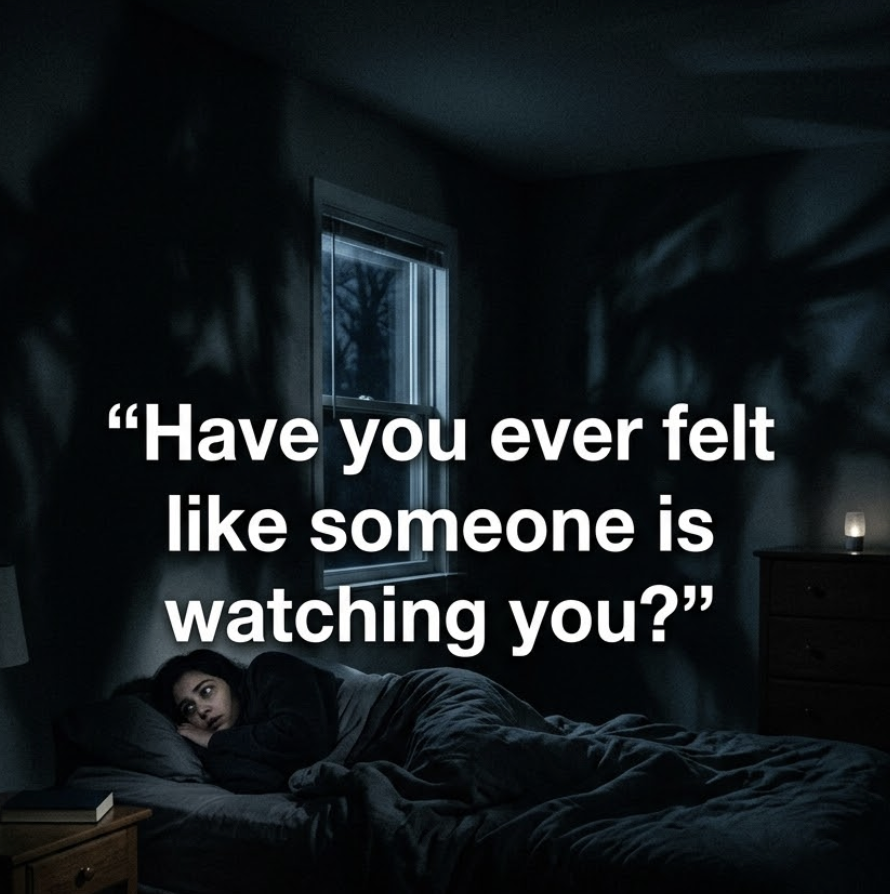
You’re home alone.
The house is quiet.
Nothing unusual has happened.
Then suddenly, a strange feeling creeps in.
It feels as if someone is watching you.
You turn around.
Nobody is there.
You check the room.
The hallway is empty.
The windows are closed.
Everything appears normal.
Yet the feeling remains.
For a few moments, your heart beats faster.
Your attention sharpens.
And no matter how much logic tells you that you’re alone, part of your brain isn’t convinced.
Why does this happen?
And why is the sensation so common that millions of people around the world have experienced it?
Most people assume the feeling comes from imagination.
Sometimes it does.
But the reality may be more interesting than that.
Humans evolved as survival-oriented creatures.
For most of history, failing to notice danger could be fatal.
Predators.
Hostile strangers.
Environmental threats.
The individuals who detected danger early were more likely to survive and pass on their genes.
As a result, the human brain developed systems designed to constantly scan the environment for potential threats.
The remarkable thing is that these systems often operate below conscious awareness.
Your brain notices far more information than you realize.
Tiny sounds.
Subtle movements.
Changes in light.
Shadows.
Unexpected silence.
A slight shift in temperature.
Most of this information never reaches conscious thought.
Yet your brain processes it anyway.
Sometimes the result is a vague feeling that something isn’t quite right.
Imagine walking through a forest thousands of years ago.
You hear a faint rustle in nearby bushes.
You don’t know what caused it.
Perhaps it’s only the wind.
But if your brain immediately dismisses it and a predator is hiding there, the consequences could be severe.
From a survival perspective, it’s often safer to assume danger first and investigate later.
Modern humans still carry that ancient wiring.
The difference is that today’s “forest” might be a quiet apartment, a dark hallway, or an empty parking garage.
The environment has changed.
The brain has not.
Researchers sometimes describe this as a form of hypervigilance.
When people are stressed, anxious, tired, or emotionally overwhelmed, the brain becomes even more sensitive to potential threats.
This heightened state can make ordinary stimuli feel significant.
A floorboard creaks.
A shadow shifts.
A distant noise echoes through the house.
Suddenly your attention locks onto it.
Your mind begins asking questions.
What was that?
Did something move?
Is someone there?
The more attention you give the feeling, the stronger it can become.
Darkness often amplifies the experience.
Humans rely heavily on vision to understand the world.
When visibility decreases, the brain receives less reliable information.
To compensate, it starts filling in the gaps.
This doesn’t mean you’re hallucinating.
It means your brain is trying to build the most complete picture possible with limited information.
A coat hanging on a chair may briefly resemble a person.
A shadow may seem to move.
An ordinary sound may feel unusually important.
The brain would rather create a false alarm than miss a genuine threat.
From an evolutionary standpoint, false alarms are usually safer.
Scientists have also studied an interesting phenomenon called the “sensed presence.”
Some people report feeling another person nearby even when nobody is present.
This experience has been documented in situations involving isolation, exhaustion, extreme stress, mountain climbing expeditions, sleep deprivation, and certain neurological conditions.
People often describe it the same way.
Not seeing someone.
Not hearing someone.
Simply knowing—or feeling—that another presence is there.
Researchers believe this may occur when the brain’s systems for tracking the body’s position and surroundings become temporarily confused.
When the brain struggles to correctly process information about the self, it may mistakenly interpret some signals as belonging to another presence.
The result can feel surprisingly real.
What makes the experience so powerful is that emotion often arrives before logic.
Your body reacts first.
Heart rate increases.
Muscles tense.
Attention narrows.
Only afterward does the rational part of the brain begin evaluating the situation.
That sequence helped our ancestors survive.
If early humans stopped to analyze every possible threat before reacting, they might not have survived long enough to finish the analysis.
So the brain evolved to act quickly.
Sometimes too quickly.
Interestingly, feeling watched does not always happen because you’re afraid.
It can also occur when you’re deeply focused, emotionally vulnerable, grieving, or alone for extended periods.
In these moments, the brain becomes more sensitive to subtle cues in the environment.
A small change that would normally go unnoticed may suddenly feel meaningful.
That is one reason many people report these experiences late at night.
The world becomes quieter.
Distractions disappear.
And the brain has more opportunity to notice every tiny sound and sensation.
The most fascinating part is that the feeling itself is not necessarily a mistake.
Your brain is doing exactly what it evolved to do.
It is scanning for danger.
Searching for patterns.
Trying to protect you.
The problem is that the system cannot always distinguish between a real threat and an uncertain possibility.
So sometimes it chooses caution.
Even when there is nothing there.
The twist is that you may not be “imagining things” at all.
Your brain may simply be running one of the oldest survival programs humans possess.
A program designed to detect danger before it becomes obvious.
Most of the time, there is no threat.
No hidden stranger.
No mysterious watcher.
Just a brain working overtime to keep you safe.
And perhaps that is why the feeling can be so unsettling.
Because for a few brief moments, your mind treats an invisible possibility as if it were real.
And even when logic wins, a small part of you still wonders:
Why did it feel so convincing?
Have you ever been completely alone and suddenly felt as if someone was watching you?
Leave a Reply