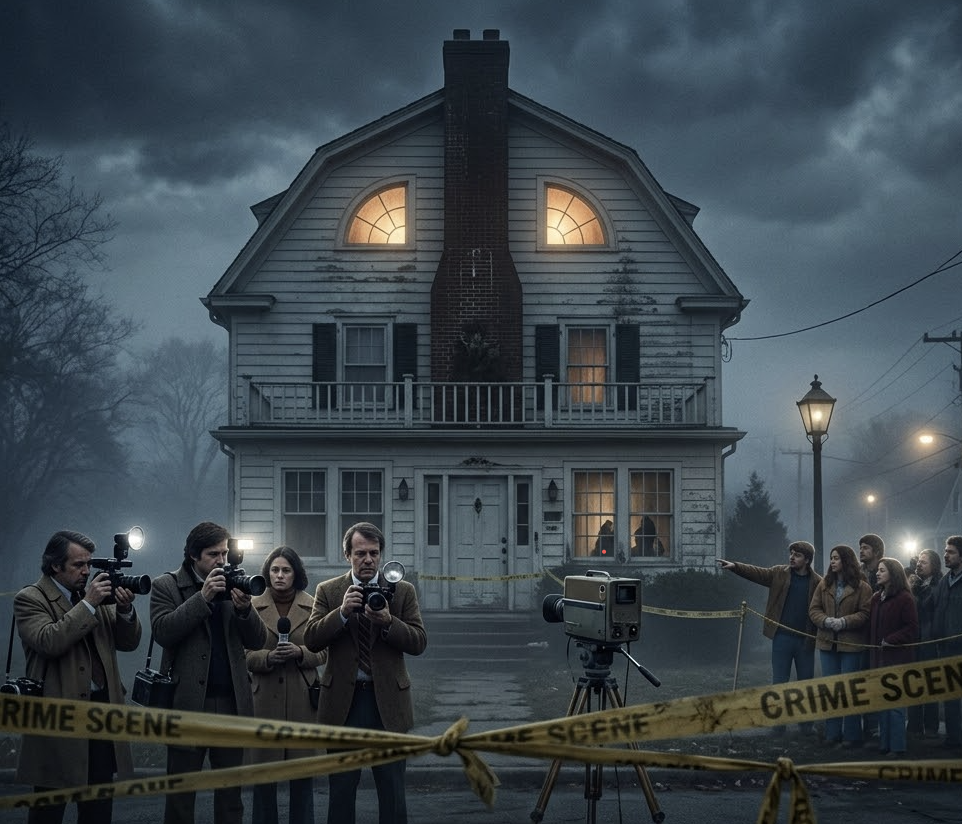
A quiet suburban house.
A family hoping for a fresh start.
And a story so controversial that it has divided believers and skeptics for nearly half a century.
Some people consider it one of the most famous haunting cases ever reported.
Others see it as one of the most successful modern myths in American history.
Yet regardless of what people believe, the Amityville story has never truly disappeared.
It remains one of the most debated mysteries in American popular culture.
The House Before the Legend
Long before stories of ghosts and supernatural forces captured public attention, the house in Amityville, New York, was connected to a very real tragedy.
On the night of November 13, 1974, six members of the DeFeo family were killed inside the home.
The crime shocked the nation.
Investigators eventually arrested Ronald DeFeo Jr., the eldest son, who was later convicted of the murders.
The case generated enormous media attention.
Newspapers covered every detail.
Television reports followed the investigation closely.
For many Americans, the house became permanently linked to one of the most disturbing family crimes of the decade.
Yet the story that would make the house world-famous had not happened yet.
A New Family Moves In
In December 1975, George and Kathy Lutz purchased the property.
The price was attractive, partly because of the house’s recent history.
The Lutz family hoped they had found an opportunity to build a new life in a spacious waterfront home.
At first, everything seemed normal.
They moved in with their children and began settling into their new surroundings.
But according to the family, unusual events soon began occurring.
George Lutz later claimed he frequently woke up at exactly 3:15 a.m.
Strange sounds reportedly echoed through parts of the house.
Cold spots appeared in rooms.
Doors allegedly opened and closed on their own.
The family described an increasing sense of fear and discomfort.
As the days passed, they claimed the atmosphere inside the house became impossible to ignore.
The Sudden Departure
The most surprising part of the story was how quickly it unfolded.
According to the Lutz family, the situation became so frightening that they abandoned the house after only twenty-eight days.
They left behind furniture, clothing, and many personal belongings.
Friends and relatives reportedly helped them leave in haste.
Soon afterward, the family began sharing details of what they claimed had happened inside the home.
The story immediately attracted public attention.
America was fascinated.
The combination of a real murder case and reports of supernatural activity proved irresistible to both the media and the public.
A Story That Spread Across the World
In the years that followed, the Amityville story grew far beyond a local news event.
Books were written.
Television specials aired.
Documentaries explored the claims.
Most famously, a bestselling book titled The Amityville Horror helped introduce the story to millions of readers.
Hollywood soon followed.
Movies based on the events became box-office successes and turned the house into a global cultural icon.
For many people, Amityville became the definitive haunted house story.
Its image entered popular culture and remained there for decades.
Even people who knew little about the details often recognized the name.
The Debate Begins
As the story became more famous, scrutiny increased.
Journalists, investigators, paranormal researchers, and skeptics all began examining the family’s claims.
Some believed the Lutz family genuinely experienced something unusual.
Others questioned whether the events had been exaggerated.
Critics pointed out inconsistencies in certain accounts.
Some argued that many reported phenomena lacked independent verification.
Several investigators suggested that publicity and financial incentives may have influenced parts of the story.
Supporters responded by insisting that unusual experiences are often difficult to document and that a lack of proof does not necessarily mean nothing occurred.
The debate continued year after year.
And unlike many mysteries, it never reached a conclusion that satisfied everyone.
What Happened to the House?
One of the most frequently discussed aspects of the Amityville story involves the people who lived there afterward.
Over the decades, additional owners occupied the house.
Most did not publicly report the dramatic paranormal experiences described by the Lutz family.
Skeptics viewed this as evidence against the haunting claims.
Believers argued that different people can experience the same place in different ways.
As a result, the mystery only became more complicated.
The house itself remained standing.
Life continued around it.
Yet the stories attached to its walls never fully faded.
Beyond Ghost Stories
Part of what makes Amityville so fascinating is that it exists at the intersection of fact and legend.
The murders of the DeFeo family were real.
The house was real.
The Lutz family was real.
What remains disputed are the extraordinary claims that followed.
Unlike many ghost stories that begin with folklore, Amityville began with documented tragedy.
That foundation gave the later claims a sense of authenticity that captured the public imagination.
Whether people accepted those claims or rejected them, they rarely ignored them.
The Mystery That Never Ends
Today, decades after the events first captured headlines, Amityville continues to inspire books, films, podcasts, and debates.
Some people see it as evidence that unexplained phenomena can occur.
Others view it as a cautionary example of how stories evolve through media attention and public fascination.
What makes the case endure is not that anyone has definitively proven the house was haunted.
Nor is it that anyone has completely disproven every claim.
Instead, the mystery survives because it sits in the uncomfortable space between certainty and belief.
The Amityville house became more than a building.
It became a symbol.
A place where documented history collided with extraordinary storytelling.
And perhaps that is the real reason people still talk about it.
Not because everyone agrees on what happened.
But because after all these years, no one has managed to convince everyone else that they are wrong.
Leave a Reply