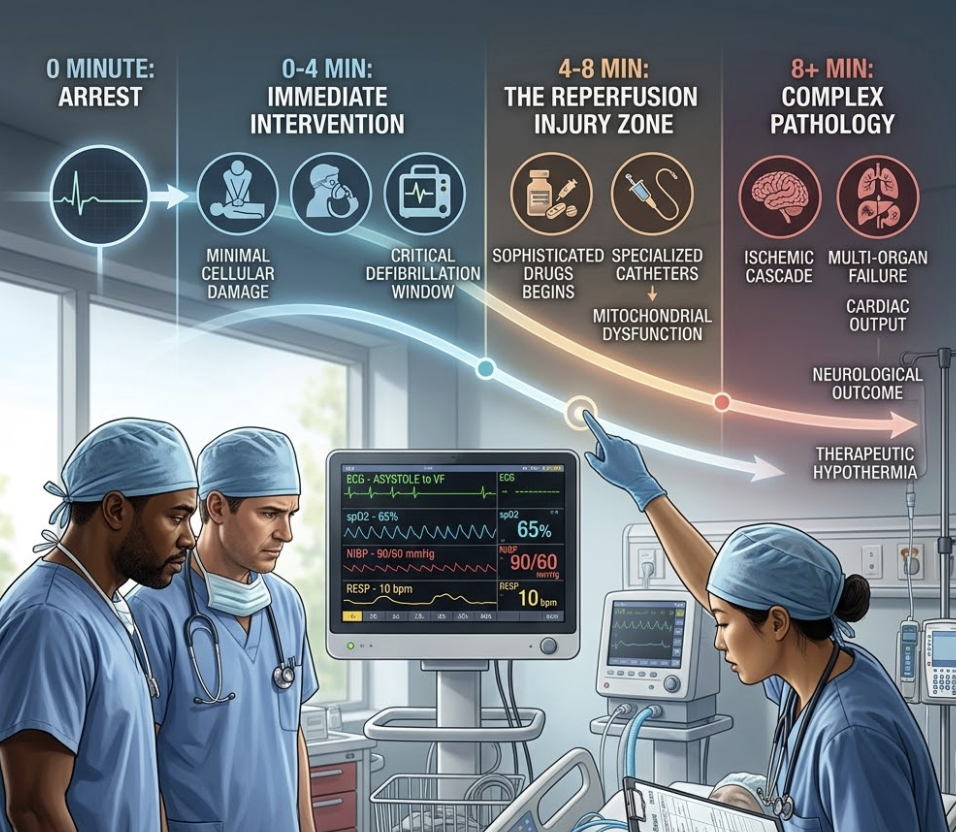
A heart stops beating.
For many people, that moment seems like an instant ending.
The image is simple: the heart stops, life stops.
But the reality is far more complex.
The human body does not shut down like a machine with a power switch.
Instead, what follows is a series of biological events that unfold over seconds and minutes.
Some processes stop immediately.
Others continue briefly.
And during those first critical moments, an extraordinary race against time begins.
It is a race that determines whether life can be restored or permanently lost.
The Moment the Heart Stops
The heart’s primary job is simple but essential.
It pumps blood throughout the body.
That blood carries oxygen and nutrients to every organ and tissue.
When the heart suddenly stops, circulation stops with it.
Blood is no longer moving efficiently.
Oxygen is no longer being delivered where it is needed.
The effects begin almost immediately.
Within seconds, blood pressure collapses.
The brain receives less oxygen.
Most people lose consciousness very quickly, often within ten seconds or less.
They become unresponsive.
They can no longer interact with the world around them.
Yet even at this point, not everything inside the body has stopped functioning.
The Body Does Not Shut Down Instantly
One of the most surprising facts about cardiac arrest is that millions of cells remain alive for a short time afterward.
Cells do not die the instant blood flow stops.
Many still contain small reserves of oxygen and stored energy.
Chemical reactions continue.
Proteins continue working.
Cellular processes continue trying to maintain normal function.
The problem is that these reserves are limited.
Without fresh oxygen, the body’s emergency clock begins ticking.
Every passing minute matters.
Why the Brain Is So Vulnerable
Among all organs, the brain is one of the most sensitive to oxygen deprivation.
Although it represents only a small percentage of body weight, it consumes a tremendous amount of energy.
Neurons require a constant supply of oxygen to function properly.
When that supply disappears, changes begin rapidly.
Within minutes, brain cells start experiencing severe stress.
Electrical activity becomes disrupted.
Communication between neurons begins to break down.
The longer circulation remains absent, the greater the risk of irreversible injury.
This is why medical professionals treat cardiac arrest as one of the most urgent emergencies in medicine.
The brain has very little margin for error.
The Golden Minutes
Emergency responders often refer to the first few minutes after cardiac arrest as the golden window.
During this period, immediate intervention can dramatically improve survival chances.
Cardiopulmonary resuscitation, commonly known as CPR, helps maintain some blood flow to vital organs.
Even though CPR cannot fully replace the heart, it can deliver enough circulation to slow the damage caused by oxygen deprivation.
Defibrillators can sometimes restore a normal heart rhythm if used quickly.
The sooner circulation returns, the greater the chance of recovery.
This is why rapid emergency response saves lives.
The body may still be fighting for survival even after the heart has stopped.
What Happens Inside the Brain?
One of the most fascinating areas of modern research involves the brain’s activity immediately after cardiac arrest.
For many years, scientists assumed brain activity simply faded away once circulation stopped.
Recent studies suggest the process may be more complicated.
Researchers have observed brief changes in electrical activity during the moments following cardiac arrest.
Some studies have even recorded short bursts of organized brain activity after circulation ceases.
Scientists are still trying to understand exactly what these patterns mean.
Do they represent the brain’s final attempt to maintain function?
Are they related to memory processing?
Could they help explain some reports of near-death experiences?
At present, there are no definitive answers.
But these discoveries have opened new areas of investigation into consciousness and the dying process.
The Mystery of Near-Death Experiences
For decades, some people who survived cardiac arrest have reported vivid experiences.
Descriptions vary widely.
Some report intense feelings of peace.
Others describe memories, dreams, or unusual perceptions during periods when they were clinically unconscious.
Scientists continue studying these accounts.
Some researchers believe they may be connected to the brain’s response to extreme stress and oxygen deprivation.
Others argue there is still much we do not understand about consciousness itself.
What remains clear is that the brain is far more active and complex during critical medical events than once believed.
When Damage Begins
Despite the body’s remarkable resilience, there is a limit to how long organs can survive without oxygen.
As minutes pass, cells begin experiencing irreversible injury.
The brain is usually affected first.
Other organs eventually follow.
The exact timeline varies depending on factors such as temperature, overall health, and whether any blood flow continues through CPR or other interventions.
This is why every minute matters.
Medical teams often describe cardiac arrest as a battle against time itself.
The goal is simple:
Restore circulation before permanent damage occurs.
Modern Medicine and Survival
Advances in emergency medicine have dramatically improved survival rates in many situations.
Rapid CPR training.
Public access defibrillators.
Improved emergency response systems.
Advanced hospital care.
All of these developments exist because scientists and physicians have spent decades studying what happens during those critical first minutes.
Today, countless people survive cardiac arrest who might not have survived in previous generations.
Many return to normal lives.
Some remember nothing of the event.
Others remember fragments.
But all benefited from one crucial fact:
The body does not stop fighting the moment the heart stops.
The Race Inside Every Cell
Perhaps the most surprising truth is that cardiac arrest is not an immediate ending.
It is the beginning of a biological countdown.
A race occurring inside every organ.
Every tissue.
Every cell.
The heart may have stopped.
But countless microscopic processes continue struggling to survive.
This brief window is what makes modern resuscitation possible.
It is why CPR matters.
It is why emergency response matters.
And it is why people can sometimes return to life even after their hearts have ceased beating.
The most important thing happening after the heart stops is not silence.
It is time.
And for a few precious minutes, time can still make all the difference.
Leave a Reply