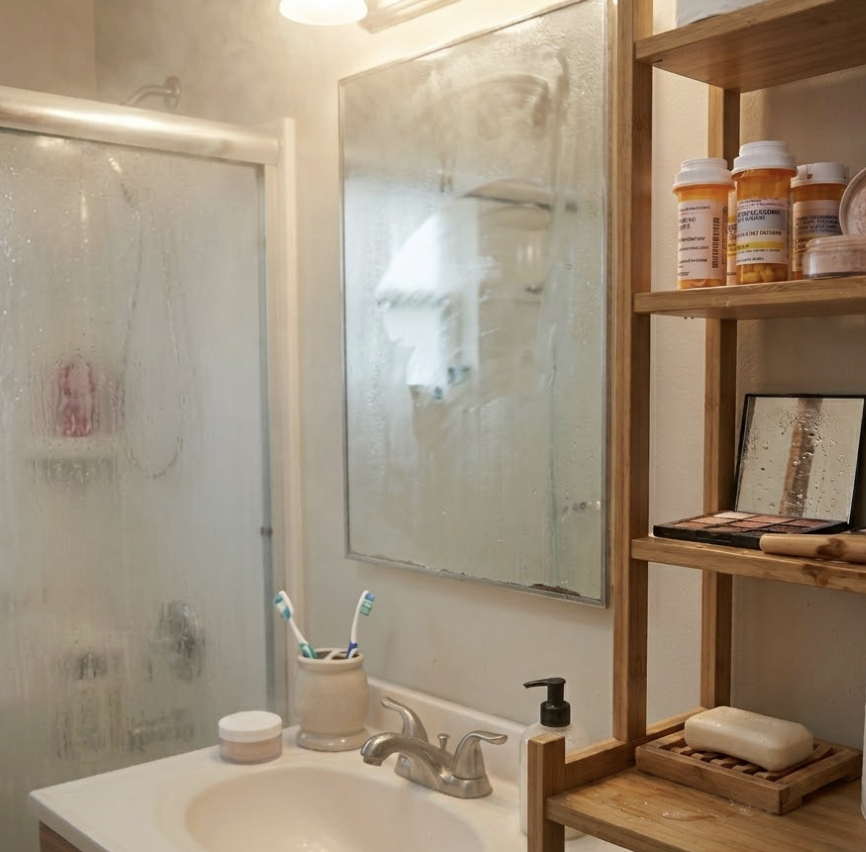
For many households, the bathroom becomes a convenient storage space.
Medicine cabinets hold pills and vitamins.
Shelves are filled with cosmetics and skincare products.
Drawers contain razors, jewelry, and personal items.
It seems practical.
After all, these are things people use every day.
But what many homeowners don’t realize is that the bathroom is often one of the worst places in the house for storing certain items.
The reason isn’t obvious.
It’s something you usually can’t even see.
Humidity.
Why Bathrooms Create Problems
Every time someone takes a hot shower, the environment inside the bathroom changes dramatically.
Warm air fills the room.
Moisture rises.
Surfaces collect condensation.
Then, once the shower ends, temperatures begin to drop again.
This cycle repeats day after day, year after year.
While people quickly become accustomed to these changes, many household items do not handle them well.
Even if an object looks perfectly normal from the outside, repeated exposure to moisture and fluctuating temperatures can slowly affect its quality and lifespan.
Medications
One of the most common items stored in bathrooms is medication.
For decades, medicine cabinets above bathroom sinks have been considered the traditional place to keep pills and prescriptions.
However, many manufacturers recommend storing medications in cool, dry locations instead.
Excess humidity can affect certain medicines over time, potentially reducing their effectiveness.
While not every medication reacts the same way, experts often advise checking storage instructions carefully.
A bedroom drawer or closet shelf may provide a more stable environment than a bathroom cabinet.
Cosmetics and Skincare Products
Beauty and skincare products are also frequent bathroom residents.
Moisturizers.
Foundations.
Serums.
Creams.
Makeup products often sit only a few feet away from sinks and showers.
The problem is that many cosmetic formulas contain ingredients that perform best when stored at consistent temperatures.
Frequent exposure to heat and humidity may cause some products to deteriorate faster, change texture, or lose effectiveness sooner than expected.
Keeping products in a cooler environment can often help extend their shelf life.
Razors
A razor may seem perfectly suited for the bathroom.
After all, that’s where it’s used.
Yet storing razor blades in a constantly humid environment can cause problems.
Moisture can accelerate corrosion and dull blades more quickly.
Many people assume their razor simply wears out naturally.
In reality, excessive exposure to humidity may shorten its useful life.
Allowing blades to dry completely between uses can help maintain their performance longer.
Books, Documents, and Paper
Paper and moisture rarely work well together.
Books left in bathrooms often develop warped pages.
Magazines can become wavy and damaged.
Important documents may deteriorate over time if repeatedly exposed to humid air.
Even when no water directly touches the paper, moisture in the environment can gradually affect its condition.
Items such as certificates, legal documents, photographs, and treasured keepsakes are generally safer elsewhere in the home.
Jewelry
Many people remove jewelry before showering and leave it on bathroom counters.
While occasional exposure may not cause immediate problems, long-term humidity can affect certain metals and materials.
Some pieces may tarnish faster.
Others may lose their original appearance more quickly than expected.
This is especially true when jewelry is stored close to showers, bathtubs, or sinks where moisture levels remain high.
A jewelry box kept in a dry room is often a better option.
Electronics
Another item that quietly finds its way into many bathrooms is electronics.
Phones, tablets, electric toothbrush chargers, and other devices frequently spend time in humid conditions.
While many modern electronics are designed with some level of protection, prolonged exposure to moisture can still create risks.
Condensation and humidity are rarely ideal companions for sensitive electronic components.
Keeping devices away from excessive steam can help reduce potential problems over time.
Towels Aren’t Always Safe Either
Even towels can be affected.
Many people assume bathrooms are the natural place to store extra towels.
However, if the room lacks proper ventilation, moisture can linger in fabrics longer than expected.
This may create conditions that encourage odors or mildew growth.
Well-ventilated linen closets often provide a better storage solution.
The Science Behind the Problem
The surprising part is that direct contact with water is often not the main issue.
Most damage comes from invisible moisture suspended in the air.
After a hot shower, humidity levels inside a bathroom can rise dramatically.
Even though the air eventually appears normal again, tiny amounts of moisture continue interacting with surfaces and objects throughout the room.
Over months and years, those effects accumulate.
The process is gradual enough that many people never notice it happening.
Yet it continues every day.
A Small Change With a Big Impact
The good news is that protecting many household items doesn’t require expensive solutions.
Often, simply moving them to a cooler, drier location is enough.
A bedroom drawer.
A hallway closet.
A dedicated storage cabinet.
Small changes in where items are kept can significantly extend their lifespan and help preserve their quality.
The bathroom may be one of the most convenient rooms in the house.
But convenience and proper storage are not always the same thing.
Sometimes the best way to protect everyday items is simply to move them a few steps away from the steam that quietly surrounds them after every shower.
Leave a Reply