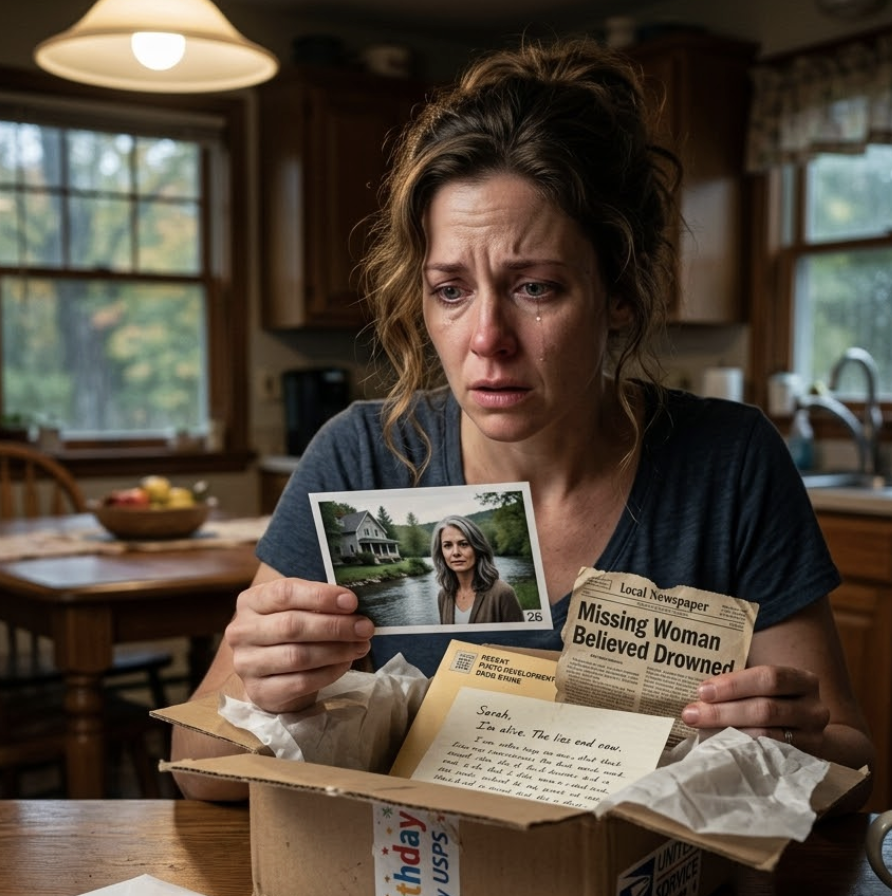
Three Lines That Changed Everything
The package arrived on the twentieth anniversary of my sister’s death.
No return address.
No explanation.
And inside was a photograph proving she had been alive after the day everyone buried her.
My sister Emily died when I was twelve years old.
At least that’s what everyone told me.
The accident happened on a rainy October night.
A truck crossed the center line.
A small sedan was crushed.
Three people died.
The newspapers called it tragic.
The town called it heartbreaking.
My family called it the worst day of our lives.
Emily was nineteen.
Beautiful.
Smart.
The kind of person everyone remembered.
The kind of person who seemed destined for something bigger than our small town.
Then suddenly she was gone.
Or so I believed.
The funeral took place four days later.
Closed casket.
The explanation seemed reasonable.
The crash had been severe.
The damage extensive.
Nobody questioned it.
Nobody asked to see her.
Nobody demanded proof.
People rarely do when grief arrives.
My parents cried for months.
My father never fully recovered.
My mother stopped celebrating birthdays.
Family photographs disappeared from the walls.
Emily’s bedroom remained untouched for years.
Everything looked exactly like a family mourning a daughter.
So I mourned too.
As the years passed, Emily became a memory.
Then a story.
Then almost a ghost.
Twenty years later, on the anniversary of her death, I received a package.
At first I assumed it was a mistake.
The box had no sender information.
No company markings.
Nothing.
Just my name.
The handwriting looked oddly familiar.
Not enough to recognize.
Enough to feel uncomfortable.
I opened it at the kitchen table.
Inside sat a small wooden box.
Old.
Scratched.
Weathered.
A birthday gift.
At least that’s what the attached card claimed.
The card contained only one sentence.
“Happy birthday, Katie. Sorry I’m late.”
I froze.
Because nobody called me Katie anymore.
Only Emily had.
Nobody else.
Not friends.
Not relatives.
Not even my parents.
Only Emily.
A chill ran through me.
I immediately called my mother.
She assumed someone was playing a cruel joke.
My father refused to discuss it.
My husband suggested throwing the box away.
Instead I opened it.
Inside rested a photograph.
The moment I saw it, my entire world changed.
The picture showed Emily.
There was no doubt.
Not someone resembling her.
Not a lookalike.
Emily.
Standing beside a lake.
Smiling directly at the camera.
Alive.
Healthy.
And undeniably older than nineteen.
My heart started pounding.
Then I noticed the date.
Printed in the corner.
Three months after the car accident.
Three months after her funeral.
Three months after everyone said she died.
The photograph slipped from my fingers.
Because suddenly one impossible truth stood in front of me.
Emily had been alive.
After her death.
After her burial.
After the mourning.
After everything.
I spent that night examining the photograph.
Again and again.
Searching for evidence of manipulation.
Editing.
Forgery.
Anything.
There was none.
The paper was old.
The ink authentic.
Even the clothing matched fashions from that period.
The image was real.
The next morning I drove to my parents’ house.
The moment my mother saw the photograph, she nearly collapsed.
My father turned pale.
For several seconds nobody spoke.
Then my father did something strange.
He left the room.
Without explanation.
Without a word.
That reaction bothered me more than anything else.
Because it wasn’t confusion.
It wasn’t shock.
It looked like fear.
The following weeks became an obsession.
I contacted the police.
Private investigators.
Former reporters who covered the crash.
Anyone connected to the case.
The official records remained unchanged.
Emily Bennett.
Deceased.
Victim of motor vehicle collision.
Case closed.
Yet the photograph remained.
A fact that refused to fit.
Then another package arrived.
This one contained a newspaper clipping.
No note.
No explanation.
Just an article.
The article covered the accident.
At first glance it looked ordinary.
Then I noticed a sentence highlighted in yellow.
“Due to severe fire damage, authorities relied primarily on personal effects to identify one victim.”
I read the line three times.
Then four.
Because suddenly something occurred to me.
Nobody actually identified Emily’s body.
The identification relied on belongings.
Her purse.
Her jewelry.
Her driver’s license.
Objects.
Not her.
The realization sent me searching through old files.
Insurance documents.
Hospital records.
Coroner reports.
Everything.
Then I discovered something strange.
Emily’s dental records were never compared.
DNA testing was never performed.
The body was simply assumed to be hers.
Assumed.
One word.
One assumption.
One life-changing possibility.
Then came the biggest discovery yet.
A retired state trooper agreed to meet me.
He investigated the crash twenty years earlier.
When I showed him the photograph, his expression changed immediately.
Not surprise.
Recognition.
He remembered something.
Something he never included in the report.
The night before the accident, Emily filed a complaint at a local police station.
Not against a stranger.
Against her fiancé.
According to the trooper, Emily claimed she was afraid.
Terrified, actually.
She believed her fiancé was watching her.
Following her.
Controlling her.
The complaint never went anywhere.
No crime had occurred.
No arrest was made.
The report disappeared into storage.
Then Emily died less than twenty-four hours later.
Or supposedly died.
The retired trooper looked at the photograph again.
Then quietly said:
“I always wondered if she ever got on that car.”
Those words haunted me.
Because for the first time, someone else saw what I saw.
Maybe Emily wasn’t a victim of the crash.
Maybe she was never there.
And if she wasn’t there…
Then who was buried in her place?
The question consumed me.
If Emily wasn’t in the car…
Then who was?
And why would someone go to such extraordinary lengths to make the world believe she was dead?
The answer began with a woman named Laura Simmons.
I had never heard the name before.
But the retired trooper had.
Laura was twenty-two years old.
A waitress.
No close family.
No permanent address.
And according to old records, she vanished the same week Emily supposedly died.
Completely vanished.
No missing person investigation.
No media coverage.
No grieving relatives demanding answers.
Nothing.
Because nobody was looking for Laura.
The more I researched, the stranger things became.
Laura and Emily looked remarkably alike.
Not identical.
But similar enough that a burned body could easily be mistaken for either woman.
Especially if investigators already believed one of them was inside the vehicle.
Then I found something hidden inside Emily’s old bedroom.
My parents had finally allowed me to go through her belongings.
Most of it was ordinary.
Books.
Photographs.
Letters.
Then, inside a hollow section of her closet wall, I discovered a metal box.
Inside sat a journal.
Emily’s journal.
The final entries were written days before the accident.
And every page made my blood run colder.
According to Emily, her fiancé, Mark, had become increasingly dangerous.
At first it was jealousy.
Then control.
Then threats.
Then violence.
She wrote about bruises.
Fear.
Surveillance.
She even suspected he had access to her bank accounts and personal mail.
One entry stood out above all others.
“If anything happens to me, it won’t be an accident.”
I sat frozen.
Because suddenly the car crash no longer looked random.
The final journal entry was dated the morning of the accident.
Only six sentences.
“Mom knows everything now.”
“We’re leaving tonight.”
“She says nobody can ever know.”
“Dad would try to stop us.”
“If this works, Katie will hate me.”
Then one final line.
“But she’ll be alive to hate me.”
I started crying before I finished the sentence.
Because suddenly I knew.
Emily hadn’t disappeared alone.
My mother was involved.
The photograph.
The panic.
My father’s strange reaction.
Everything pointed in the same direction.
That night I confronted my mother.
For nearly an hour she denied everything.
Then I showed her the journal.
The fight left her instantly.
Her shoulders collapsed.
Her eyes filled with tears.
And finally, after twenty years, she told me the truth.
Emily never got into the car.
The crash happened exactly as reported.
Three people died.
But Emily wasn’t one of them.
The plan began after the police ignored her complaint against Mark.
My mother became convinced he would eventually kill her.
Not might.
Would.
She had seen enough.
The bruises.
The threats.
The fear.
So she helped Emily disappear.
New identification.
Cash.
A safe location.
Everything prepared secretly.
The crash happened hours after Emily left town.
When investigators mistakenly identified one victim as Emily, my mother made a choice.
The hardest choice of her life.
She stayed silent.
Because correcting the mistake would expose Emily’s location.
And if Mark found her, everything would be over.
I stared at my mother in disbelief.
“All these years?”
She nodded.
Crying now.
“I thought I was saving her.”
The tragedy didn’t end there.
Because the twist wasn’t simply that Emily survived.
The twist was far worse.
Two years after her disappearance, Mark was arrested.
Not for hurting Emily.
For murdering another woman.
A woman named Rachel Harper.
The case finally exposed years of violence, stalking, and abuse.
Everything Emily had feared became public.
Everything police ignored became evidence.
Everything my mother believed turned out to be true.
Had Emily stayed, she might have become another victim.
The realization nearly broke me.
Because for twenty years I hated the sister who abandoned us.
The sister who missed birthdays.
Missed holidays.
Missed funerals.
Missed life.
Yet she hadn’t abandoned anyone.
She had been surviving.
Then my mother handed me something.
A photograph.
Recent.
Only six months old.
Emily standing beside a small house.
Gray beginning to appear in her hair.
A little older.
A little sadder.
But alive.
On the back she had written:
“If Katie ever learns the truth, tell her I never stopped loving her.”
That sentence destroyed me.
Three months later I stood in front of that house.
Thousands of miles from home.
Heart pounding.
Hands shaking.
The door opened.
And there she was.
For a moment neither of us moved.
Twenty years vanished in an instant.
Then she started crying.
And so did I.
The reunion wasn’t perfect.
Nothing after twenty years could be.
Too much life had happened.
Too many memories were missing.
Too many wounds remained.
But she was alive.
And suddenly every unanswered question mattered less.
The birthday gift wasn’t meant to reveal a mystery.
It was an invitation.
A bridge.
A way back.
Years later, I still think about that photograph.
The one taken after her supposed death.
The image that shattered everything I believed.
Because the final twist wasn’t that Emily survived.
It wasn’t that my mother helped her disappear.
It wasn’t even that the wrong woman was buried.
The final twist was that every year, on the anniversary of the crash, Emily mailed herself a birthday card addressed to me.
She never sent them.
She kept them in a box.
Twenty years of unsent letters.
Twenty years of missed birthdays.
Twenty years of loving a sister from a distance.
The package I received was simply the first one she finally had the courage to mail.
Leave a Reply