Three Lines That Changed Everything
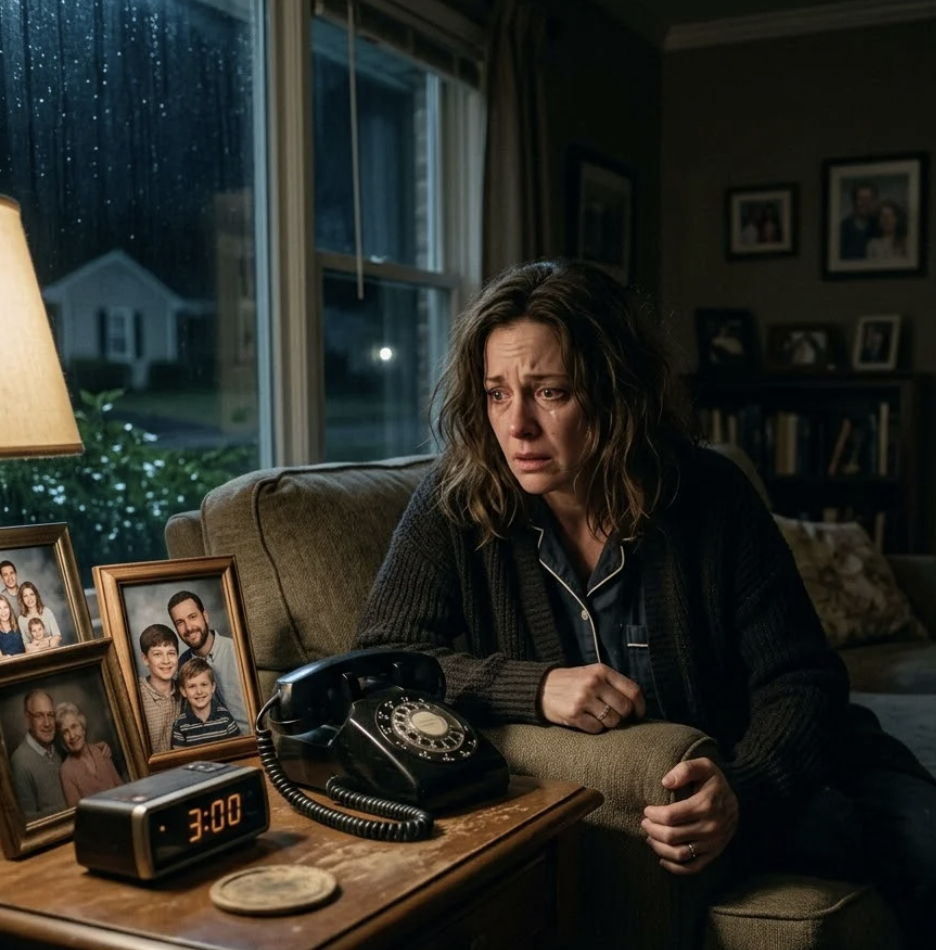
Every night at exactly 3:00 a.m., our house phone rang.
My father never allowed anyone else to answer it.
The night after his funeral, I finally picked up—and a woman whispered, “At last. You’re listening.”
For as long as I can remember, the phone rang at 3:00 a.m.
Not sometimes.
Not occasionally.
Every single night.
The timing never changed.
Three o’clock exactly.
Not 2:59.
Not 3:01.
Three.
The first ring usually woke me.
The second woke my father.
The third never happened.
Because by then he was already answering.
I used to sit on the stairs and listen.
His voice was always different during those calls.
Softer.
Older.
Afraid.
He never shouted.
Never argued.
Never laughed.
Most conversations lasted less than two minutes.
Sometimes only seconds.
Then he’d hang up and sit alone in the dark kitchen.
Thinking.
Waiting.
Like a man expecting something terrible.
When I asked who was calling, he always gave the same answer.
“Wrong number.”
Children believe strange things.
For years, I believed that explanation.
Until I was old enough to realize wrong numbers don’t happen every night for twenty years.
My name is Michael Grant.
And my father spent most of his life running from something.
He changed phone numbers constantly.
We moved houses three times.
He refused to appear in public records whenever possible.
Bills were registered under variations of his name.
Mail went through post office boxes.
He paid cash for almost everything.
At the time I thought he was paranoid.
Now I know he was afraid.
The strange thing was that none of his precautions worked.
No matter where we moved.
No matter what number he changed to.
The 3 a.m. call always found us.
Always.
The mystery became such a normal part of life that eventually I stopped questioning it.
People adapt to almost anything.
Even impossible things.
Then my father died.
A stroke.
Sudden.
Unexpected.
One moment alive.
The next gone.
The funeral happened three days later.
Relatives arrived.
Stories were shared.
Photos displayed.
People described him as quiet.
Private.
Reserved.
Nobody mentioned the phone calls.
Nobody except me.
The first night after the funeral, I slept in my childhood bedroom.
The house felt wrong without him.
Too quiet.
Too empty.
I couldn’t sleep.
So I sat awake watching the clock.
2:57.
2:58.
2:59.
Then—
The phone rang.
The sound hit me like lightning.
Because for the first time in my life, nobody was there to answer.
The first ring echoed through the house.
The second ring followed.
My heart pounded.
The third ring never came.
Because I grabbed the receiver.
“Hello?”
Silence.
For a moment I thought the line was dead.
Then a woman spoke.
Softly.
Carefully.
Almost reverently.
“Michael?”
Every hair on my body stood up.
“Yes.”
The woman began crying.
Not loudly.
Not dramatically.
The quiet crying of someone who has waited years for something.
Finally she whispered:
“Thank God.”
I couldn’t speak.
Then she said the sentence that changed everything.
“At last.”
A pause.
“You’re listening.”
I gripped the receiver tighter.
“Who is this?”
More silence.
Then:
“You were born on October 17th.”
My stomach tightened.
The woman continued.
“You weighed six pounds, four ounces.”
I froze.
“You have a birthmark behind your left shoulder.”
The receiver nearly slipped from my hand.
Because she was right.
Perfectly right.
The birthmark wasn’t visible.
Almost nobody knew about it.
Certainly no stranger should.
My voice shook.
“Who are you?”
The woman answered immediately.
A single word.
One word that shattered my world.
“Mother.”
The line went dead.
I didn’t sleep at all that night.
The next morning I convinced myself it had been a prank.
A cruel coincidence.
A misunderstanding.
Yet deep down, I already knew.
The woman knew things she shouldn’t know.
Things impossible to guess.
Things only family would know.
The following night I waited beside the phone.
At exactly 3:00 a.m., it rang again.
This time I answered immediately.
The woman sounded calmer.
As though she had rehearsed this conversation for years.
Perhaps she had.
For nearly an hour we talked.
Not about dramatic revelations.
Not at first.
Instead she asked questions.
Simple questions.
What foods did I like?
Did I have children?
Was I healthy?
Was I happy?
The questions felt strangely maternal.
Painfully maternal.
Eventually I interrupted.
“Who are you really?”
The woman hesitated.
Then answered.
“My name is Sarah.”
The name meant nothing to me.
Until she added:
“It used to be Sarah Bennett.”
Something in her voice broke.
“As far as the world knows, I died twenty-six years ago.”
A chill ran through me.
The next week became an obsession.
I hired a private investigator.
Tracked phone records.
Followed old documents.
Every clue pointed toward the same place.
A psychiatric hospital.
Long abandoned.
Long forgotten.
Located three states away.
The facility shut down more than a decade earlier.
Most records were destroyed.
Most staff were dead.
Yet enough survived.
Enough to uncover a story nobody was supposed to find.
The hospital had housed long-term psychiatric patients.
Women.
Mostly.
Several admitted under controversial circumstances.
Some voluntarily.
Some not.
One patient stood out immediately.
Sarah Bennett.
Admitted twenty-six years earlier.
Diagnosis:
Obsessive delusional disorder.
Primary delusion:
Belief that her newborn son had been stolen.
My pulse accelerated.
I kept reading.
According to the records, Sarah spent years insisting hospital staff had switched her baby.
She claimed another family paid to take him.
She claimed documents were falsified.
She claimed she knew her son was alive.
Nobody believed her.
Doctors dismissed the story.
Psychiatrists labeled it fixation.
Family members stopped visiting.
Friends disappeared.
Over time she became little more than a file.
A diagnosis.
A forgotten woman trapped inside an institution.
Yet one detail refused to leave my mind.
She never changed her story.
Not once.
For twenty-six years.
Every interview.
Every evaluation.
Every report.
The same claim.
“My son was taken.”
Most delusions evolve.
Shift.
Mutate.
Hers never did.
That terrified me.
Because suddenly it sounded less like insanity.
And more like memory.
Then I found something else.
A sealed folder marked confidential.
Inside sat an old photograph.
A woman holding a newborn baby.
The woman was Sarah.
The baby was me.
PART 2
I stared at the photograph for a long time.
The baby looked ordinary.
A newborn wrapped in a hospital blanket.
Tiny.
Helpless.
Unaware that his entire life had already been decided.
My life.
The date on the back matched my birthday exactly.
The woman’s name matched the caller.
And for the first time, I began considering something impossible.
What if Sarah wasn’t delusional?
What if everyone else was wrong?
I spent the next month chasing records.
Birth certificates.
Hospital archives.
Adoption files.
Court documents.
Most of them led nowhere.
Some had disappeared.
Others had been sealed.
The deeper I dug, the stranger everything became.
Then I found my father’s safety deposit box.
The bank had contacted me weeks earlier, but grief delayed everything.
Now I finally opened it.
Inside were only three items.
A stack of cash.
An old photograph.
And a sealed envelope.
The envelope was addressed to me.
My father’s handwriting covered the front.
The sight of it made my stomach tighten.
Because suddenly I knew.
He had expected this.
Expected the phone call.
Expected the questions.
Expected me to discover the truth.
The letter began simply.
“If you’re reading this, then Sarah finally found a way to reach you.”
My hands started shaking.
I continued reading.
According to my father, thirty-one years earlier he worked as a hospital maintenance supervisor.
Not wealthy.
Not powerful.
Just an ordinary employee struggling to pay bills.
One night a wealthy couple approached him through an intermediary.
The couple had experienced a tragedy.
Their newborn son died shortly after birth.
The mother suffered a psychological breakdown.
The father became desperate.
Then someone proposed an impossible solution.
Another baby had been born the same night.
Healthy.
Alive.
Unprotected.
A baby belonging to a young woman with no money and almost no family support.
My heart pounded.
Because I already knew who that woman was.
Sarah.
The letter confirmed it.
My father never participated in the switch itself.
At least that’s what he claimed.
The exchange had already happened.
Records had already been altered.
Hospital staff had already been bribed.
The crime was already complete.
What they needed was someone willing to disappear with the child.
Someone willing to raise him under a new identity.
Someone desperate enough to accept money.
That someone became my father.
The next paragraph nearly broke me.
“I told myself I was rescuing you.”
“I told myself you would have a better life.”
“I told myself Sarah would eventually move on.”
“Every one of those things was a lie.”
I stopped reading.
Tears blurred the page.
Because for the first time, I could hear regret in my father’s voice.
Real regret.
Not justification.
Not excuses.
Regret.
The letter explained why the phone calls began.
Sarah never stopped searching.
Never.
She filed complaints.
Appeals.
Petitions.
Lawsuits.
She contacted newspapers.
Investigators.
Politicians.
Anyone who might listen.
Nobody did.
Eventually her obsession became the evidence used against her.
The more she insisted her son was stolen, the more unstable she appeared.
The richer family protected themselves.
Lawyers became involved.
Doctors signed evaluations.
Judges approved commitments.
And Sarah disappeared into the psychiatric system.
Not because she was crazy.
Because nobody wanted to admit she was right.
Then came the detail that haunted me most.
The calls.
For twenty-six years.
Every single night.
Three o’clock.
Exactly.
The hospital allowed long-term patients one monitored phone call during overnight hours.
Three o’clock was Sarah’s assigned slot.
The only time she could call.
The only time she could try again.
The only time she could hear her son’s voice.
My father knew.
He always knew.
That’s why he answered.
Every night.
For twenty-six years.
Not because he feared her.
Because he felt guilty.
The realization crushed me.
All those nights.
All those conversations.
All those years.
I had imagined a stalker.
A threat.
A mystery.
Instead it was a mother refusing to forget her child.
And a man unable to escape what he had done.
The final pages of the letter revealed something even more devastating.
The wealthy family that orchestrated everything didn’t keep me.
Their marriage collapsed within two years.
The father disappeared.
The mother died from an overdose.
The people responsible never became my parents.
My father did.
The man who accepted the money.
The man who participated.
The man who spent the rest of his life trying to compensate for a terrible decision.
He returned most of the money anonymously over the years.
Paid for private investigations into Sarah’s case.
Attempted to have her released.
Tried repeatedly to confess.
Then backed out every time.
Cowardice.
Fear.
Shame.
All of it.
The final sentence of his letter destroyed me.
“I stole your past, Michael. But loving you was the only honest thing I ever did.”
Three weeks later I met Sarah.
Not over the phone.
In person.
The state had transferred her to a small assisted-living facility after the hospital closed.
She was seventy-one.
Fragile.
Gray-haired.
Much smaller than I expected.
When she saw me, she didn’t cry immediately.
She simply stared.
As though she were afraid I might disappear.
Then she reached out and touched my face.
The same way mothers do when they can’t quite believe something is real.
We sat together for hours.
No dramatic speeches.
No accusations.
No anger.
Just questions.
Thousands of questions delayed by three decades.
She showed me photographs.
Hospital records.
Letters she wrote but never sent.
Birthday cards.
Christmas cards.
Thirty years of motherhood trapped inside boxes.
And suddenly I understood something.
I had two parents.
One gave me life.
One raised me.
One spent thirty years looking for me.
One spent thirty years regretting how I came into his life.
Both loved me.
Neither escaped the consequences of what happened.
People often ask who I consider my real parent.
The answer disappoints them.
Because life isn’t that simple.
Sarah is my mother.
The man who raised me was also my father.
Both statements are true.
Both always will be.
But sometimes, late at night, I still wake up a few minutes before three.
And when the clock changes to exactly 3:00 a.m., I think about a woman trapped inside a hospital for twenty-six years.
A woman everyone called delusional.
A woman who never changed her story.
A woman who kept calling.
Night after night.
Year after year.
Because somewhere deep inside her, she knew the truth.
And eventually, the truth answered the phone.
Leave a Reply