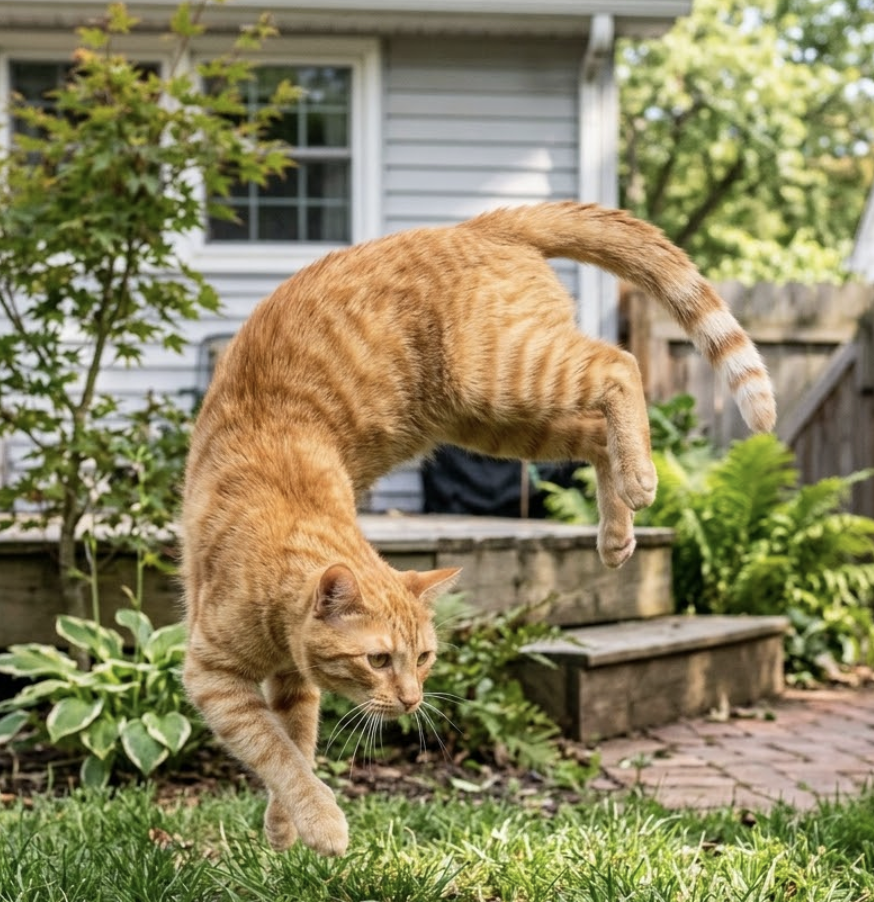
A cat slips from a fence.
Falls from a table.
Jumps from a tree branch.
For a brief moment, it seems certain the animal will hit the ground awkwardly.
Then something remarkable happens.
The cat twists in midair.
Its body rotates.
Its paws point downward.
And it lands on its feet.
To many people, it looks like magic.
Almost as if cats possess some secret ability that breaks the laws of physics.
But the truth is even more fascinating.
What appears to be a miracle is actually one of the most impressive survival mechanisms found in nature.
The Mystery That Fascinated Scientists
For centuries, people noticed that cats seemed unusually good at surviving falls.
The phenomenon became so famous that scientists eventually began studying it in detail.
One question kept appearing:
How can a cat change its position while falling?
A falling object shouldn’t be able to rotate without pushing against something.
Yet cats somehow managed it.
The answer revealed a remarkable combination of biology, physics, and evolution.
The Moment a Cat Starts Falling
The process begins almost instantly.
The moment a cat loses balance, its body detects the change.
Deep inside the inner ear is a structure called the vestibular system.
Humans have it too.
It helps us understand balance and orientation.
Cats possess an extremely sensitive version of this system.
As soon as the fall begins, the cat’s brain knows exactly where its head is relative to the ground.
The information arrives in fractions of a second.
Before many humans would even realize they are falling, a cat has already started correcting its position.
The Incredible Midair Twist
The first thing a cat does is rotate its head.
It turns to face downward.
Then something extraordinary happens.
The front half and back half of the body begin moving independently.
The cat bends its spine.
Its front legs pull inward.
Its rear legs extend outward.
This changes how different parts of the body rotate.
Using these movements, the cat can twist itself without violating the laws of physics.
The front half turns first.
Then the rear half follows.
Within moments, the entire body aligns with the ground.
Scientists call this the “righting reflex.”
Most kittens begin developing it when they are only a few weeks old.
By adulthood, the movement becomes almost automatic.
Why Cats Are So Flexible
One reason this ability works so well is the cat’s skeleton.
Cats possess exceptionally flexible spines.
Their vertebrae allow a greater range of motion than many other mammals.
This flexibility gives them remarkable control during a fall.
Their bodies can bend, twist, and rotate in ways that seem impossible.
If humans attempted similar movements, we would quickly discover the limitations of our own anatomy.
Cats, however, evolved for agility.
Their hunting lifestyle rewarded balance, coordination, and rapid body control.
Over millions of years, those traits became highly refined.
Preparing for Impact
Once the cat successfully rotates, another phase begins.
Now it must survive the landing.
As the ground approaches, the cat spreads its legs outward.
This increases air resistance slightly.
The body relaxes rather than remaining rigid.
The legs prepare to absorb impact.
When contact occurs, the joints act like shock absorbers.
The force travels through the limbs rather than concentrating in one location.
This greatly reduces the risk of injury.
The landing may look effortless.
In reality, countless adjustments occur within fractions of a second.
The Surprising Truth About High Falls
Many people assume that the higher a cat falls, the more dangerous the fall becomes.
Interestingly, reality is more complicated.
Veterinarians have documented cases where cats survived extremely high falls.
Some researchers believe this happens because cats eventually reach terminal velocity—the maximum speed at which they fall.
Once that speed is reached, they stop accelerating.
At that point, cats often relax their bodies and spread their limbs, creating a parachute-like effect.
This does not make high falls safe.
But it may explain why some cats survive falls that seem impossible.
The phenomenon has fascinated veterinarians for decades.
Why Low Falls Can Be More Dangerous
This is where the story becomes unexpected.
A short fall can sometimes be more dangerous than a longer one.
Why?
Because the cat may not have enough time to complete its righting reflex.
The rotation process requires a certain amount of time and distance.
If a cat falls only a short distance, it may hit the ground before fully adjusting its body.
In those situations, the landing can be awkward and potentially harmful.
The ability that makes cats famous depends on having enough time to work.
Not Every Fall Ends Well
The phrase “cats always land on their feet” is not entirely accurate.
Many cats do.
But not all.
Falls can still cause broken bones.
Internal injuries.
Head trauma.
And in severe cases, death.
Age also matters.
Young kittens may not have fully developed their righting reflex.
Older cats may lose some flexibility and reaction speed.
Medical conditions can affect balance as well.
The famous ability is impressive, but it is not invincible.
The Evolutionary Advantage
From an evolutionary perspective, the righting reflex makes perfect sense.
Cats evolved as climbers and hunters.
They leap.
Pounce.
Climb trees.
Walk along narrow surfaces.
A species that spends so much time above the ground benefits enormously from being able to recover from falls.
Natural selection rewarded individuals who survived mistakes.
Over generations, those survival advantages became part of the species itself.
The result is one of nature’s most elegant defensive systems.
The Scientific Twist
The most amazing part of the story is that cats do not break the laws of physics.
They use them.
Every twist.
Every rotation.
Every adjustment follows precise physical principles.
The movements are so fast and so efficient that they appear supernatural.
But beneath the mystery lies extraordinary biology and engineering.
The real twist is that cats are not performing magic at all.
They are demonstrating one of the most sophisticated survival reflexes evolution has ever produced.
And perhaps that is even more impressive.
Because the next time you watch a cat land gracefully on its feet, you’re not seeing a trick.
You’re witnessing millions of years of evolution working perfectly in the space of a single second.
Leave a Reply