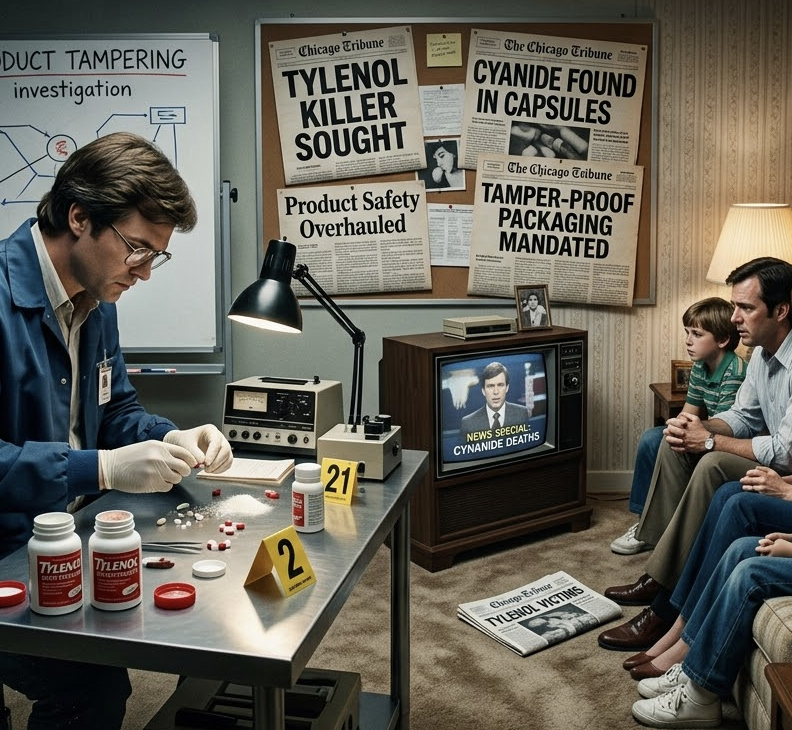
A few capsules sitting in a medicine cabinet.
A trusted product found in millions of American homes.
Something so ordinary that most people never thought twice about using it.
Yet in the fall of 1982, those small capsules became the center of one of the most frightening criminal investigations in American history.
The Tylenol murders did more than claim lives.
They changed the way Americans thought about safety, trust, and the products they used every day.
The Beginning
In late September 1982, residents around the Chicago area began hearing reports of sudden and unexplained deaths.
The victims seemed to have nothing in common.
They came from different backgrounds.
Different neighborhoods.
Different ages.
At first, the deaths appeared unrelated.
But investigators soon discovered a chilling connection.
Each victim had recently taken Extra-Strength Tylenol, one of the most popular over-the-counter pain relievers in the United States.
The discovery immediately raised alarms.
Tylenol was trusted.
Families kept it in their homes.
Parents gave it to their children.
Millions of Americans used it without hesitation.
The idea that it could be connected to multiple deaths seemed almost impossible to believe.
Yet the evidence pointed in one direction.
A Deadly Discovery
Laboratory testing revealed that several Tylenol capsules taken by the victims contained cyanide, a highly toxic poison capable of causing death within minutes.
The finding stunned investigators.
The question was no longer whether the deaths were connected.
The question was who had done it.
And how.
As authorities examined manufacturing facilities and distribution systems, they uncovered a disturbing truth.
The contamination had not occurred inside the factory.
Instead, someone had purchased bottles from retail stores, opened them, inserted cyanide into the capsules, resealed the packages, and returned them to store shelves.
The implications were terrifying.
Anyone could unknowingly purchase one of the poisoned bottles.
Anyone could become a victim.
The attack appeared random.
Invisible.
And impossible to predict.
Panic Across America
News of the poisonings spread rapidly.
Television networks interrupted regular programming.
Newspapers devoted front pages to the story.
Consumers rushed to inspect medicine cabinets in their homes.
Many people threw away pain relievers.
Others refused to purchase over-the-counter medication altogether.
Stores removed Tylenol products from their shelves.
Some hospitals received calls from frightened patients asking whether medicines in their homes were safe.
For many Americans, the fear came from the randomness of the crime.
There was no warning.
No specific target.
The victims were simply ordinary people performing an ordinary act.
Taking medication they believed would help them feel better.
The Investigation
Law enforcement agencies launched one of the largest product-tampering investigations in American history.
Federal agents, local police departments, and medical experts worked together to identify the person responsible.
Thousands of leads were examined.
Numerous suspects were investigated.
Tips poured in from across the country.
At various points, investigators believed they were close to solving the case.
Yet the breakthrough never came.
Despite years of work, countless interviews, and extensive forensic analysis, authorities were never able to definitively identify and convict the person responsible for the original poisonings.
The mystery only deepened public fascination.
How could such a major crime remain unsolved?
How could someone commit an act that affected the entire nation and then seemingly disappear?
A Corporate Response That Became a Model
As the crisis unfolded, manufacturer Johnson & Johnson faced enormous pressure.
The company made a decision that would later become a case study in crisis management.
Millions of bottles of Tylenol were recalled from store shelves across the country.
The recall cost the company hundreds of millions of dollars.
At the time, it was one of the largest product recalls in American history.
The goal was simple.
Protect consumers first.
Rebuild trust later.
The response helped restore confidence in the brand, but it also highlighted a larger problem.
Consumer products were vulnerable to tampering after leaving the factory.
Something had to change.
How the Case Changed Everyday Life
One of the most lasting effects of the Tylenol murders can still be seen today.
Before 1982, many products were sold without tamper-resistant packaging.
A bottle could often be opened and resealed with little evidence.
After the poisonings, manufacturers across multiple industries began redesigning packaging to make tampering easier to detect.
Foil seals.
Protective shrink wrap.
Safety caps.
Tamper-evident packaging became the new standard.
Government regulations were strengthened.
Companies developed new security measures.
Consumers became more cautious.
Many of the safety features people barely notice today exist because of lessons learned during the Tylenol crisis.
The Mystery That Remains
More than four decades later, the case continues to attract investigators, journalists, and true-crime researchers.
Advances in forensic science have prompted periodic reviews of evidence.
New theories emerge from time to time.
Suspects have been examined and reexamined.
Yet the central mystery remains unresolved.
The person who turned ordinary medicine into a deadly weapon was never conclusively identified.
And that unanswered question continues to haunt the case.
The Lasting Legacy
What makes the Tylenol murders so unsettling is not only the number of lives lost.
It is the way the crime shattered a basic assumption.
People believed that products sitting on store shelves were safe.
They believed that danger came from obvious threats.
The poisonings challenged that belief.
The victims were not targeted because of who they were.
They were targeted because they happened to purchase the wrong product at the wrong time.
The attack transformed national attitudes toward consumer safety and forced industries to rethink how products were protected.
Few criminal cases have had such a direct impact on everyday life.
The killer may never have been conclusively identified.
But the consequences of the crime are visible every time someone opens a tamper-resistant package and checks the seal before using what is inside.
In that sense, the legacy of the Tylenol murders continues to live on in millions of homes, long after the mystery itself remains unsolved.
Leave a Reply