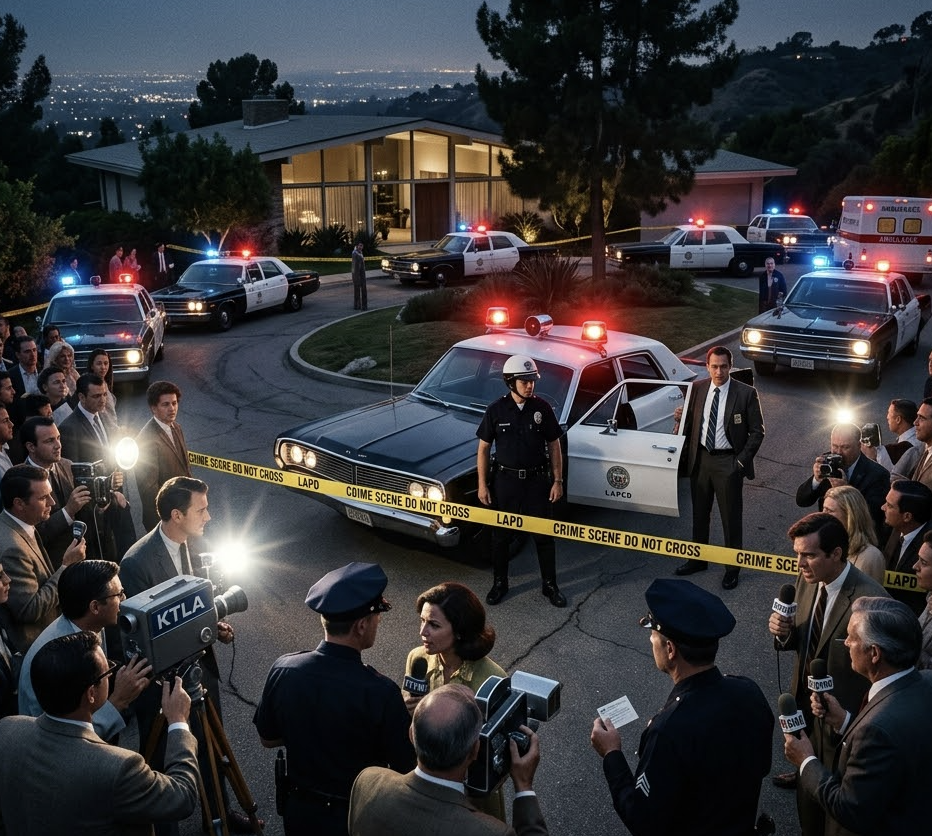
A luxury home high in the Hollywood Hills.
A warm August night in 1969.
And a crime so shocking that it changed the way America viewed fame, safety, and the darker side of the era.
More than fifty years later, the murder of Sharon Tate remains one of the most haunting and widely remembered crimes in Hollywood history.
Not only because of the lives that were lost.
But because of what the tragedy came to represent.
The Beginning
In the summer of 1969, Sharon Tate appeared to have everything ahead of her.
At just twenty-six years old, she was becoming one of Hollywood’s most promising young actresses.
Known for her beauty, charm, and growing career, she had already appeared in several films and attracted attention throughout the entertainment industry.
She was also married to film director Roman Polanski and was expecting their first child.
Friends described her as warm, kind, and optimistic about the future.
Hollywood itself seemed to embody a similar sense of possibility.
The late 1960s were remembered for cultural change, artistic experimentation, and a belief that a new generation could reshape society.
Yet beneath the surface, darker forces were already emerging.
The Night of the Crime
During the night of August 8 and the early hours of August 9, 1969, several individuals entered the home where Sharon Tate was staying in Los Angeles.
Inside the house were Sharon Tate and several friends.
The intruders were members of a group connected to Charles Manson, the leader of a cult-like movement that had attracted devoted followers through manipulation, control, and increasingly extreme beliefs.
What followed was one of the most disturbing crimes in modern American history.
By sunrise, Sharon Tate and four others had lost their lives.
The brutality of the attack shocked investigators.
News of the murders spread rapidly across the country.
Many Americans struggled to understand how such violence could occur in one of the most famous neighborhoods in the world.
The crime seemed random.
Senseless.
Almost impossible to explain.
Fear Reaches Hollywood
The impact extended far beyond the immediate tragedy.
Hollywood had long projected an image of glamour, success, and exclusivity.
Many celebrities lived behind gates and private walls, believing distance and wealth provided security.
The murders challenged that assumption.
Actors, musicians, producers, and executives suddenly began viewing their surroundings differently.
Security systems became more common.
Private guards were hired.
Gates grew taller.
People became more cautious about strangers and unexpected visitors.
For many residents of Los Angeles, the murders created a lasting sense of vulnerability.
If something like this could happen to Sharon Tate, it could happen to anyone.
The Investigation
In the beginning, investigators struggled to find a clear motive.
The victims did not appear to have been targeted because of money.
The crime scene offered few obvious explanations.
As detectives worked through evidence and witness statements, the case grew increasingly complex.
Months later, authorities began uncovering connections between the murders and Charles Manson’s group of followers.
The revelations that followed stunned the public.
The killers were not professional criminals.
They were members of a tightly controlled community influenced by Manson’s increasingly dangerous worldview.
As more details emerged, Americans became fascinated and horrified by how a charismatic leader had persuaded followers to participate in such violence.
The case quickly became one of the most closely watched criminal trials in the nation.
The Legacy of Sharon Tate
The individuals responsible were eventually arrested, prosecuted, and convicted.
Yet legal convictions could not erase the tragedy.
For many people, Sharon Tate became more than a victim of a notorious crime.
She became a symbol of a life interrupted before it could fully unfold.
Friends and family continued speaking about the person they had known rather than the headlines that followed her death.
Over time, her story became intertwined with broader discussions about fame, media attention, violence, and the cultural changes occurring in America at the end of the 1960s.
The Night That Marked an Ending
Historians often describe the murders as more than a criminal case.
They view them as a cultural turning point.
The late 1960s had been associated with idealism, artistic freedom, and hopes for social transformation.
The murders shattered some of those illusions.
The crime seemed to symbolize the darker side of an era that many had once viewed through a more hopeful lens.
Whether that interpretation is entirely fair or not, the perception became deeply embedded in public memory.
The murders came to represent the end of something larger than a single story.
The Lasting Impact
More than five decades later, the murder of Sharon Tate continues to be studied, discussed, and remembered.
Documentaries, books, films, and historical analyses continue to revisit the case.
Part of the reason is the shocking nature of the crime itself.
But another reason is what it revealed about fear, influence, and the fragility of safety.
The victims were living ordinary lives on what seemed like an ordinary evening.
Nothing about the night suggested it would become one of the most infamous crimes in American history.
And perhaps that is what continues to unsettle people.
The realization that history can change in a single night.
A promising future can disappear in a matter of hours.
And a crime can leave a mark not only on the people directly involved, but on an entire culture for generations to come.
Leave a Reply