Nobody was allowed to be late for dinner.
Not once.
Not ever.
Not for school.
Not for work.
Not for dates.
Not for emergencies.
If dinner started at 6:13 p.m., then everyone sat at the table by 6:13 p.m.
No exceptions.
That rule governed our family for over fifty years.
My grandfather, Walter Bennett, enforced it with military precision.
At exactly 6:12, he would stand beside the dining room doorway.
At exactly 6:13, he would sit down.
And if someone wasn’t there, he would begin eating without them.
No argument ever changed his mind.
No explanation mattered.
No excuse was accepted.
As children, we hated it.
As adults, we joked about it.
But nobody ever challenged it.
Because Walter Bennett wasn’t the type of man people challenged.
He had survived war.
Built a successful construction company.
Raised six children.
Buried a wife.
And somehow maintained complete authority over an entire family long after most men would have lost it.
The strange part wasn’t the rule.
The strange part was the time.
Why 6:13?
Not 6:00.
Not 6:30.
Not even 6:15.
Always 6:13.
People asked.
Grandfather never answered.
When my cousins were young, they invented theories.
Maybe it was the time he met Grandma.
Maybe it was the time he proposed.
Maybe it was connected to the war.
Maybe it was religious.
Maybe it was luck.
Nobody knew.
And Walter never explained.
The mystery became part of the family.
Something odd but harmless.
Then he died.
And the mystery stopped being harmless.
My grandfather passed away at eighty-nine.
A stroke.
Quick.
Peaceful.
The funeral filled an entire church.
Business partners.
Neighbors.
Former employees.
Veterans.
Friends.
The line stretched outside the building.
Everyone had a story about Walter Bennett.
Hardworking.
Loyal.
Honorable.
Disciplined.
Not one person described him as dangerous.
Not one.
Three days after the funeral, my father, uncles, aunts, and cousins gathered at the family home.
Someone needed to sort through Grandfather’s belongings.
The house felt strange without him.
Quieter.
Smaller.
Almost fragile.
The dining room bothered me most.
Because for the first time in my life, the chair at the head of the table sat empty.
Nobody knew where to look.
Nobody knew what to do.
So we cleaned.
Closets.
Drawers.
Basement boxes.
Attic storage.
Ordinary things.
Ordinary memories.
Then the clock fell.
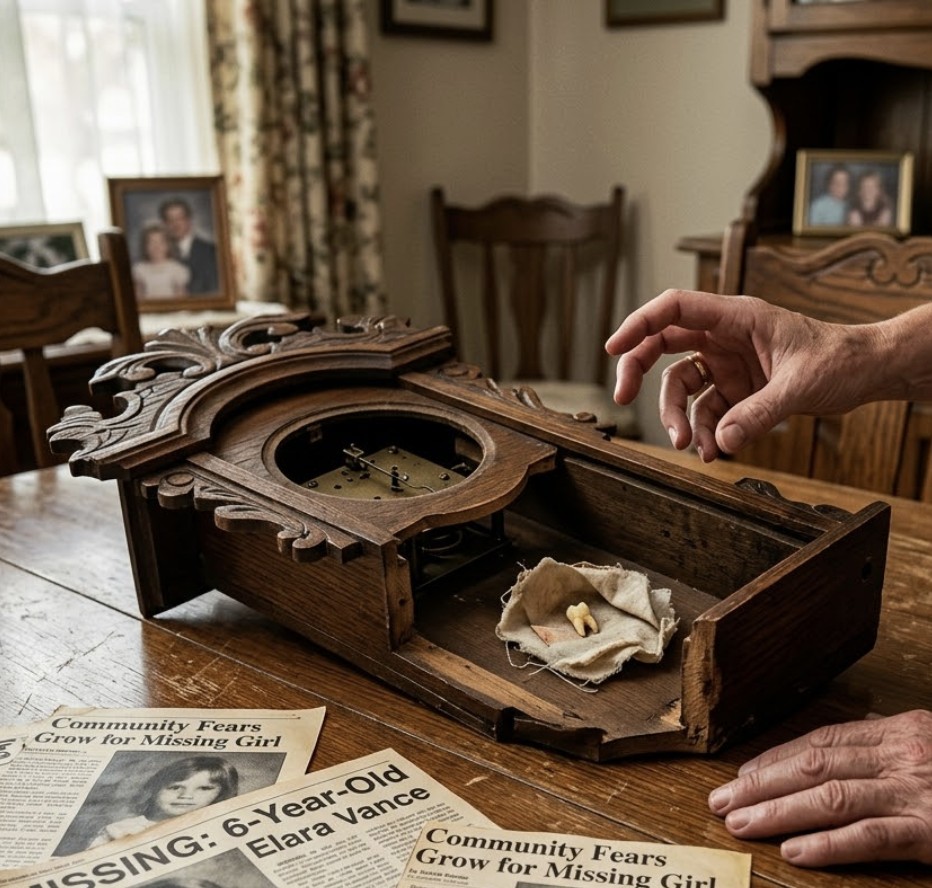
The dining room clock had hung on the wall for longer than anyone could remember.
A large wooden pendulum clock.
Heavy.
Old.
Always ticking.
Always present.
While my cousin Daniel was moving furniture, one of the wall anchors suddenly gave way.
The clock crashed to the floor.
Glass exploded.
Wood cracked.
Everyone jumped.
At first it seemed like nothing.
Just bad luck.
Then Daniel noticed something inside.
Hidden behind the clock mechanism.
Wrapped carefully in a yellowed handkerchief.
The room became quiet.
Very quiet.
Because whatever it was, Grandfather had intentionally hidden it.
My father slowly unfolded the cloth.
Then froze.
“What is that?”
Nobody answered.
Because everyone could see it.
A child’s tooth.
Small.
White.
Old.
Lying in the center of the fabric.
For several seconds nobody moved.
Then my aunt noticed something else.
Another object tucked deeper inside the clock.
A scrap of faded blue fabric.
The sleeve of a child’s shirt.
And beneath it…
A folded newspaper clipping.
The air left my lungs.
Because suddenly this wasn’t a sentimental keepsake.
It felt like evidence.
My father unfolded the clipping.
The paper was fragile.
Brittle.
Nearly sixty years old.
A black-and-white photograph occupied the center.
Missing Boy.
Age 6.
Disappeared July 1964.
The room became silent.
The child’s face stared back at us.
Round cheeks.
Dark eyes.
A nervous smile.
Ordinary.
Completely ordinary.
Until my aunt gasped.
Then my cousin.
Then my father.
And finally me.
Because the boy looked familiar.
Not vaguely familiar.
Not somewhat familiar.
Exactly familiar.
He looked like my father.
Not today’s version.
The version from childhood photographs.
The resemblance was terrifying.
Same eyes.
Same nose.
Same expression.
The room felt suddenly cold.
Nobody spoke for almost a minute.
Then my uncle whispered:
“That’s impossible.”
My father stared at the photograph.
His hands shaking.
Because he saw it too.
Everyone did.
The missing child looked more like him than his own childhood photos did.
The similarity wasn’t coincidence.
It wasn’t imagination.
It was blood.
The realization hit everyone at the same time.
And nobody wanted to say it aloud.
Because saying it would mean asking a question nobody was prepared to hear.
Who exactly was Walter Bennett?
That night I couldn’t sleep.
So I searched.
Newspaper archives.
Public records.
Old missing-person databases.
Anything connected to the article.
Eventually I found more.
The missing boy’s name was Michael Dawson.
Age six.
Vanished while walking home from a neighborhood park.
Never found.
No suspects.
No witnesses.
No body.
The case went cold within two years.
The family eventually moved away.
The mystery remained unsolved.
Until now.
Or so it seemed.
Then I found something worse.
Much worse.
An old police report mentioning a witness.
A witness who remembered seeing a truck near the park.
A construction company truck.
Owned by…
Walter Bennett Construction.
I stared at the screen.
Unable to breathe.
Unable to think.
Because suddenly the tooth.
The cloth.
The photograph.
The resemblance.
The hidden newspaper clipping.
None of it felt random anymore.
And for the first time in my life, I began wondering whether my grandfather’s greatest secret wasn’t hidden in the attic.
Or the basement.
Or the clock.
It was sitting at our family table every night for nearly sixty years.
My father.
MY GRANDFATHER FORCED THE ENTIRE FAMILY TO EAT DINNER AT 6:13 P.M. — UNTIL THE CLOCK FELL OFF THE WALL AFTER HIS FUNERAL
PART 2
The discovery destroyed our family.
Not immediately.
At first, everyone tried to explain it away.
Coincidence.
Resemblance.
Old newspaper clipping.
A sentimental keepsake.
Anything except the obvious.
Because the obvious possibility was too horrible.
Too impossible.
Too dangerous.
My father barely spoke for three days.
He carried the clipping everywhere.
Folded carefully inside his wallet.
As though looking away might somehow change what it showed.
The resemblance haunted him.
Haunted all of us.
Then the DNA test happened.
Nobody suggested it directly.
Nobody wanted to.
Yet everyone was thinking the same thing.
If the missing boy from 1964 looked exactly like my father…
There was a simple way to find out why.
Two weeks later, the results arrived.
I was sitting beside my father when he opened them.
For several seconds he simply stared at the pages.
Then lowered them.
His face had gone completely white.
“What?”
I asked.
He didn’t answer.
Instead, he handed me the report.
The words felt unreal.
Probability of biological relationship between Walter Bennett and Thomas Bennett: 0.00%
Zero.
Not uncertain.
Not low.
Zero.
Walter Bennett wasn’t my father’s biological father.
The room became silent.
Because suddenly everything changed.
Every childhood story.
Every family photograph.
Every holiday.
Every tradition.
Everything.
Then came the second report.
Investigators located surviving relatives of Michael Dawson.
The missing boy.
A nephew.
A sister.
Several distant cousins.
DNA confirmed the impossible.
My father was Michael Dawson.
The six-year-old boy who disappeared in 1964.
The child from the newspaper clipping.
The child hidden inside Grandfather’s clock.
The child everyone thought had vanished forever.
My father cried.
For the first time in my life, I watched him cry uncontrollably.
Not because he discovered a new family.
Because he lost an old one.
In a single afternoon, he learned his entire identity had been stolen.
His name wasn’t Thomas Bennett.
It never had been.
His parents weren’t his parents.
His childhood wasn’t his childhood.
Even his memories became suspect.
Because memory is fragile.
Especially memories formed when you’re six years old.
The police reopened the missing-child case immediately.
And that’s when the darkest truth emerged.
The truth hidden behind 6:13.
The truth Grandfather carried to his grave.
The truth nobody expected.
The investigation uncovered records from the summer of 1964.
Construction logs.
Police interviews.
Insurance reports.
And one incident never made public.
Two months before Michael Dawson disappeared, Walter Bennett’s real son died.
A six-year-old boy.
His name was David.
A tragic accident.
Officially.
Unofficially, the story was worse.
Much worse.
Walter had been backing a company truck out of a warehouse.
David ran behind it.
Walter never saw him.
By the time he realized what happened, it was too late.
The accident destroyed him.
Destroyed his marriage.
Destroyed his sanity.
Destroyed everything.
Witnesses described him as a different man afterward.
Withdrawn.
Obsessive.
Unstable.
Then, sixty-two days later…
Michael Dawson vanished.
A six-year-old boy.
The exact same age as David.
The exact same hair color.
The exact same height.
The exact same smile.
The coincidence no longer felt like coincidence.
Investigators pieced together the timeline.
Walter saw Michael at a park.
Followed him.
Spoke to him.
Then took him.
Not for ransom.
Not for money.
Not for revenge.
For replacement.
The realization sickened everyone.
My grandfather hadn’t kidnapped a child because he hated someone.
He kidnapped one because he couldn’t accept losing his own son.
The evidence became overwhelming.
Witness statements.
Old records.
DNA.
Even photographs.
Everything pointed toward the same conclusion.
Walter Bennett stole a grieving family’s child.
Then spent the next fifty years pretending he belonged there.
The final piece came from a notebook discovered inside a locked safe.
Grandfather’s handwriting covered every page.
Dozens of entries.
Confessions.
Memories.
Regrets.
The notebook answered the question that haunted the entire family.
Why 6:13?
The answer shattered us.
The first night Michael Dawson arrived in the Bennett house, he refused to eat.
Refused to speak.
Refused to stop crying.
He kept asking for his mother.
Kept asking to go home.
Walter wrote that he sat across from the terrified child for nearly three hours.
Then finally convinced him to take a bite of food.
The clock on the wall read 6:13 p.m.
That moment became sacred to Walter.
Because in his broken mind, that was when he got his son back.
Not David.
Michael.
But Walter stopped seeing the difference.
The notebook contained the sentence none of us will ever forget.
At 6:13, he finally sat at the table. At 6:13, I became a father again.
I had to stop reading.
So did my father.
Because suddenly fifty years of family dinners became unbearable.
Every meal.
Every holiday.
Every gathering.
All built around the moment a stolen child surrendered to exhaustion and sat down.
The tradition wasn’t a celebration.
It was a monument to a crime.
The public revelation made national news.
The Dawson family was located.
Or what remained of them.
Michael’s mother had died twenty years earlier.
Never knowing what happened to her son.
Never learning he survived.
Never learning he lived only three counties away.
That truth nearly destroyed my father.
Because for decades he believed he had no one else.
Yet somewhere, an entire family had searched for him.
Prayed for him.
Mourned him.
Buried an empty future because someone stole it.
The final twist arrived months later.
Another DNA test.
Another surprise.
One nobody expected.
My father wasn’t the only stolen child.
Investigators discovered Walter spent years searching for children who resembled David.
Michael wasn’t his first attempt.
He was simply the only one who stayed.
The realization transformed the story from tragedy into obsession.
Walter Bennett hadn’t merely kidnapped a child.
He had spent years trying to replace his dead son.
Michael happened to be the one who survived the process.
People often ask whether my father hates Walter.
The answer is complicated.
Because Walter Bennett was both things at once.
The man who stole him.
And the man who raised him.
The criminal who erased his identity.
And the father who taught him to ride a bicycle.
The monster.
And the grandfather I loved.
Some truths don’t fit neatly into categories.
This is one of them.
The biggest shock wasn’t discovering my father was kidnapped.
It wasn’t learning his real name.
It wasn’t uncovering the crime.
It was realizing that every family memory I cherished began with a terrible act.
Every birthday.
Every Christmas.
Every dinner.
Every photograph.
All traced back to a six-year-old boy who should have gone home and never did.
Today the old dining room clock sits in a museum archive.
The tooth.
The newspaper clipping.
The fabric.
All preserved as evidence.
The Bennett family still gathers occasionally.
But we no longer eat at 6:13.
Nobody can.
Because now we know what that time means.
And every time the clock reaches 6:13 in the evening, I think about a frightened little boy sitting at a stranger’s table.
A boy who spent his entire life believing he belonged there.
Leave a Reply