Four strangers called my mother “Mom” at her funeral.
Until that moment, I had spent my entire life believing I was an only child.
The funeral had already ended.
The last guests were leaving.
The priest had said his final prayer.
The casket had disappeared beneath the ground.
Then four people approached from different corners of the cemetery.
A man in his fifties.
A woman with silver hair.
A younger man wearing a military jacket.
And a woman holding a bouquet of white lilies.
None of them looked at each other.
None seemed to know the others were there.
But each one stopped in front of my mother’s grave.
And each one whispered the same word.
“Mom.”
My name is Daniel Foster.
For forty-two years, I believed my mother, Margaret Foster, had only one child.
Me.
That belief shattered in less than thirty seconds.
The first stranger noticed me staring.
His face turned pale.
The others looked equally shocked.
Almost guilty.
As if they had accidentally revealed a secret.
Before I could ask questions, all four began walking away.
I chased after them.
“Wait!”
They stopped.
“You called her Mom.”
No one answered.
The silence felt unbearable.
Finally, the oldest woman spoke.
“We shouldn’t be here.”
“Who are you?” I demanded.
She looked toward my mother’s grave.
Then back at me.
“The same thing you are.”
Before I could react, they left.
All four disappeared in different directions.
Leaving me standing alone beside fresh dirt and unanswered questions.
That night I couldn’t sleep.
The words replayed endlessly.
The same thing you are.
My mother had never mentioned other children.
Not once.
No photographs.
No stories.
Nothing.
The next morning I returned to her house.
My mother had lived alone for years after my father died.
I was the executor of her estate.
The lawyer had already given me the keys.
For hours I searched.
Closets.
Drawers.
Boxes.
Attic.
Basement.
Nothing.
No evidence of another family.
No hidden photographs.
No birth certificates.
No letters.
Just ordinary memories.
Then I remembered the safe.
My mother rarely used it.
A heavy steel box hidden behind a painting in her bedroom.
I found the key taped beneath her jewelry box.
Inside were bank documents.
Insurance papers.
Old passports.
And one black notebook.
The cover contained only three handwritten words.
FOR MY CHILDREN.
Not child.
Children.
My hands began shaking.
I opened the first page.
The handwriting was unmistakably hers.
If you’re reading this, I am gone.
And the truth can finally be told.
I closed the notebook.
My heart pounded so hard I thought I might be sick.
Everything I believed about my family suddenly felt fragile.
Like a wall beginning to crack.
I took a deep breath and continued reading.
The notebook contained names.
Five names.
Mine was last.
Before me came four others.
Emily.
Thomas.
Rachel.
Michael.
Four people I had never heard of.
Four people my mother had hidden from the world.
Or perhaps hidden from me.
Page after page explained pieces of a story so unbelievable I had to read certain sections twice.
Before marrying my father, my mother had lived a very different life.
In her twenties she moved frequently.
Different cities.
Different jobs.
Different relationships.
Each chapter of her life left behind a child.
A daughter she gave up for adoption after becoming pregnant in college.
A son whose father took full custody after a bitter court battle.
A daughter raised by relatives after financial hardship.
A son who grew up overseas with his father.
Then, years later, she met my father.
They married.
Started over.
Had me.
According to the notebook, my father knew everything.
But nobody else did.
Not grandparents.
Not cousins.
Not friends.
Not even me.
My mother spent decades secretly following the lives of the children she lost.
She kept newspaper clippings.
Graduation announcements.
Wedding notices.
Military promotions.
Every milestone.
Every achievement.
Every heartbreak she could discover from afar.
She never stopped loving them.
She simply believed she had no right to return to their lives.
Then came the most shocking page.
I know all five of you have attended this funeral.
The lawyer has instructions to contact you if you do not meet each other today.
You are family.
Whether you want to be or not.
I stared at the sentence for a long time.
She knew.
She had planned this.
Even after death.
The next day I contacted the attorney.
His reaction suggested he had expected my call.
“There is more,” he said quietly.
He handed me five sealed envelopes.
One addressed to each child.
We arranged a meeting.
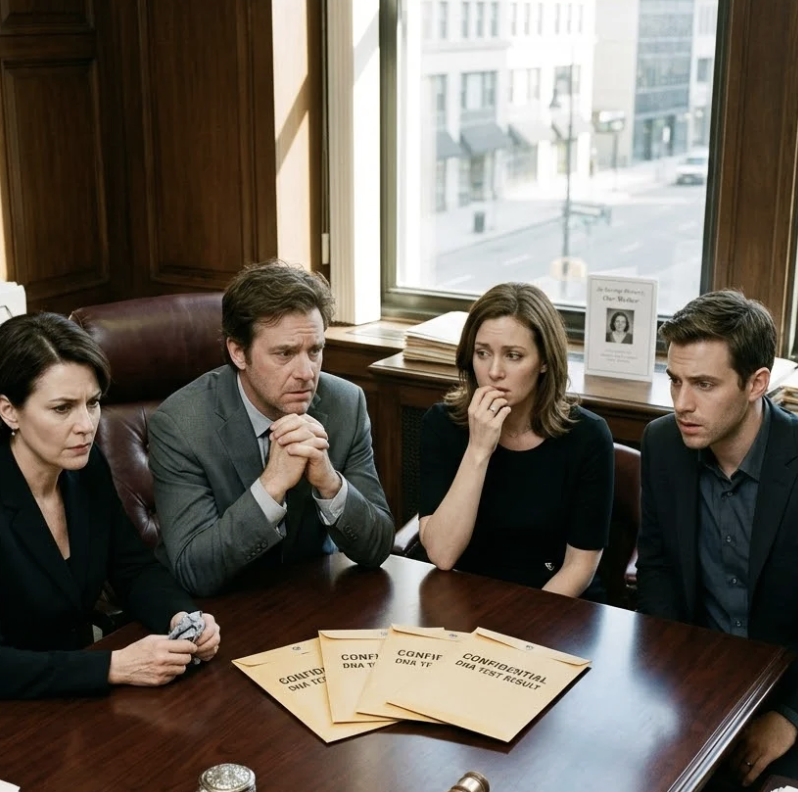
Three days later, all five of us sat around a conference table.
Awkward.
Nervous.
Suspicious.
The strangers from the cemetery looked just as overwhelmed as I felt.
For a while nobody spoke.
Then the military veteran laughed bitterly.
“Well,” he said, “this is one hell of a family reunion.”
His name was Thomas.
The silver-haired woman was Emily.
The younger woman with lilies was Rachel.
The remaining man was Michael.
One by one, they told their stories.
Each had known pieces of the truth.
None knew the entire story.
Emily knew she had been adopted.
But never knew her biological mother’s identity.
Thomas knew his mother existed somewhere.
But his father refused to discuss her.
Rachel had spent years searching unsuccessfully.
Michael believed his mother abandoned him willingly.
Every version was incomplete.
Every version contained pain.
Then we opened the letters.
Each letter was different.
But all ended with the same paragraph.
Forgive me for not being the mother you deserved.
I spent my life believing I had lost the right to call myself your mother.
Yet I never stopped being one.
The greatest regret of my life was allowing fear to separate you from one another.
Please do not inherit that fear from me.
Tears appeared around the room.
Even from people trying desperately not to cry.
For hours we talked.
About her.
About ourselves.
About the years stolen by silence.
The strangest part wasn’t discovering I had siblings.
The strangest part was realizing how familiar they felt.
Thomas had my laugh.
Rachel shared my habit of tapping her fingers when nervous.
Michael looked astonishingly similar to photographs of my grandfather.
Emily had my mother’s eyes.
By sunset we were still talking.
Still learning.
Still filling gaps in each other’s histories.
Months later, we gathered again.
Not for a funeral.
For Thanksgiving.
Then Christmas.
Then birthdays.
Slowly, awkwardly, imperfectly, a family began forming.
Not because our lives suddenly became simple.
But because the secret that had separated us was finally gone.
Years later, I often think about that day in the cemetery.
About the moment four strangers called my mother “Mom.”
For most of my life, I believed I was her only child.
I was wrong.
But the biggest surprise wasn’t discovering she had five children.
It was discovering why she left that notebook behind.
The notebook wasn’t a confession.
It wasn’t an apology.
It wasn’t even a secret.
It was an introduction.
Because even after death, my mother was still trying to do one thing she never found the courage to do while alive.
Bring her children together.
And somehow, from beyond the grave, she finally succeeded.
Leave a Reply