PART 1
My mother spent thirty years loving me too much.
And my sister not enough.
At least that’s what everyone believed.
Especially my sister.
Especially me.
If there was one truth our family never questioned, it was this:
Mom adored me.
Mom barely tolerated Emma.
Growing up, the difference was impossible to miss.
When I got sick, Mom slept beside my bed.
When Emma got sick, Mom left medicine on the nightstand.
When I won awards, Mom framed every certificate.
When Emma won awards, they disappeared into drawers.
When I cried, Mom held me.
When Emma cried, Mom left the room.
It wasn’t abuse.
That would’ve been easier to understand.
It was distance.
Coldness.
Avoidance.
The kind that slowly convinces a child she isn’t wanted.
Emma stopped trying by the time she was twelve.
Stopped asking for affection.
Stopped asking for approval.
Stopped asking for explanations.
By sixteen, she barely spoke to our mother.
By twenty-five, she had moved across the country.
The only reason she returned home was because Mom was dying.
Cancer.
Aggressive.
Terminal.
The doctors gave her months.
She survived six weeks.
Even at the end, nothing changed.
Mom asked for me constantly.
Asked whether I had eaten.
Whether I was sleeping.
Whether I was taking care of myself.
Meanwhile Emma sat quietly in hospital chairs like a visitor.
Not a daughter.
A visitor.
Sometimes I caught her staring at Mom.
Not angrily.
Not even sadly.
Just confused.
As though she had spent her entire life trying to solve a puzzle nobody would explain.
The last conversation Emma ever had with our mother lasted less than two minutes.
Mom looked at her.
Opened her mouth.
Started crying.
Then turned away.
That was it.
No apology.
No explanation.
Nothing.
Three days later she died.
The funeral felt strange.
Not because of grief.
Because of relief.
Everyone seemed exhausted.
Decades of tension.
Decades of silence.
Decades of unanswered questions.
Now there would never be answers.
Or so we thought.
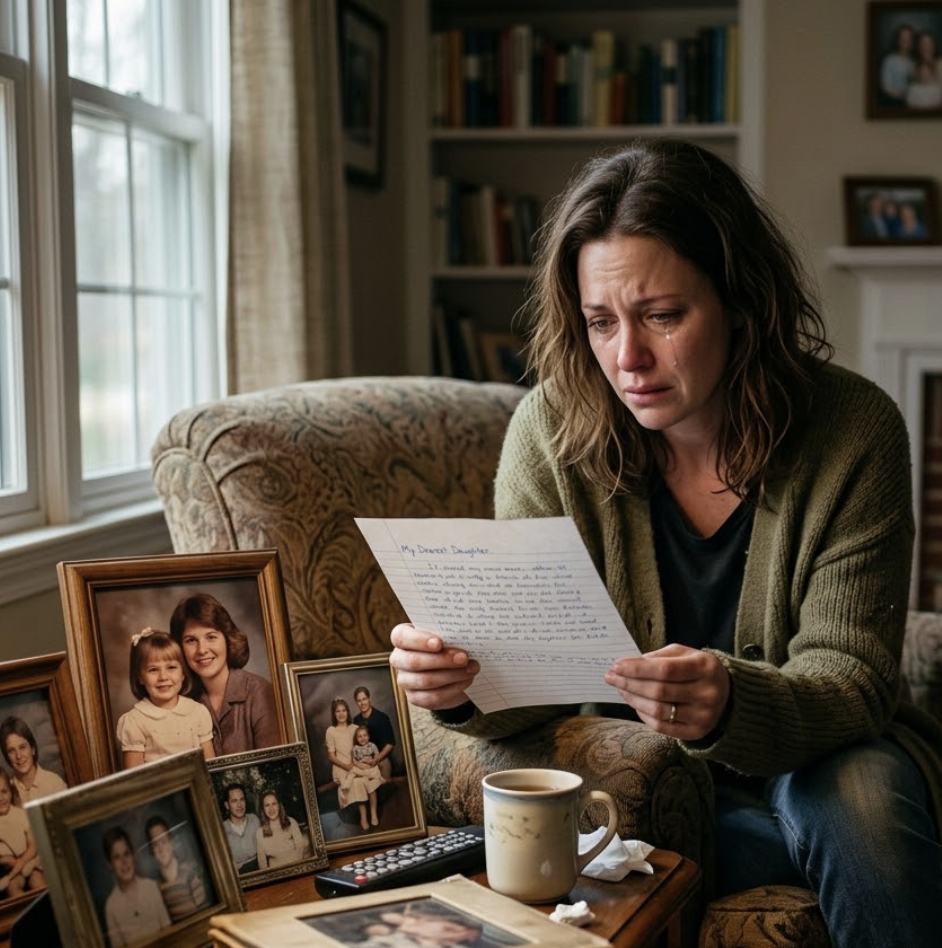
The letter appeared six days after the funeral.
I found it hidden inside Mom’s sewing cabinet.
A place she used almost daily.
The envelope carried one name.
Emma.
Only Emma.
My sister stared at it for a long time before opening it.
Then her face changed.
Color disappeared.
Her hands began shaking.
Finally she handed the pages to me.
The first sentence punched the air from my lungs.
My dearest Emma, I never hated you. I was simply too ashamed to look at you.
I looked up.
Emma was already crying.
The letter continued.
Page after page.
Confessions.
Memories.
Regrets.
Then came the story neither of us had ever heard.
A fire.
Thirty-one years earlier.
Before either of us could remember.
A fire so terrible that it changed everything.
According to Mom, the blaze started shortly after midnight.
An electrical fault.
Old wiring.
The house filled with smoke within minutes.
Dad was working a night shift.
Mom was alone with two toddlers.
Me and Emma.
At least that was what we believed.
Then came the sentence that made my hands tremble.
There were three children in that house.
I read it twice.
Then three times.
Three children.
Not two.
The room suddenly felt smaller.
Because I knew exactly what that meant.
There was someone we had never heard about.
Someone erased.
Someone missing.
The letter described chaos.
Smoke everywhere.
Heat.
Screaming.
Darkness.
Mom couldn’t see.
Couldn’t breathe.
Couldn’t think.
She crawled through the hallway searching for us.
Searching for children she could barely locate through the smoke.
Then she found one.
A little girl.
Crying.
Terrified.
Alive.
Mom grabbed the child and ran.
Back outside.
Into the yard.
Into safety.
Only then did she realize something.
The girl she rescued wasn’t Emma.
And she wasn’t me.
She belonged to the family next door.
The letter slipped from my hands.
I picked it up again.
Then read the paragraph three more times.
Because my brain refused to accept it.
The little girl my mother rescued wasn’t Emma.
And she wasn’t me.
She belonged to the family next door.
For a moment nothing made sense.
If that was true, then why were Emma and I alive?
Where were we during the fire?
What happened afterward?
The answers waited on the next pages.
My mother described the chaos in agonizing detail.
The flames spread faster than anyone expected.
The neighboring house caught fire almost immediately.
People screamed.
Windows shattered.
The entire street became a nightmare of smoke and panic.
When my mother escaped with the child she believed she’d saved, firefighters forced her away from the house.
She begged to go back.
They wouldn’t let her.
The roof collapsed minutes later.
Everyone assumed the remaining children were dead.
Including her.
Including the police.
Including the entire town.
Then came the twist that changed everything.
Hours later, rescue workers discovered two surviving toddlers.
Hidden beneath a partially collapsed laundry room.
Alive.
Barely.
One was Emma.
One was me.
The problem was that nobody knew who I was.
The neighboring family had died.
Their records burned.
Their identification disappeared.
And I was too young to tell anyone my name.
The authorities faced a horrible situation.
Three surviving children.
One grieving mother.
Two dead families.
And no way to identify one of the toddlers with certainty.
The confusion lasted days.
Then weeks.
My mother explained that everyone became focused on rebuilding.
Funerals.
Insurance claims.
Investigations.
Loss.
The town wanted closure.
So did the authorities.
Then came the mistake.
The terrible mistake.
The one that haunted my mother for the rest of her life.
The doctors concluded Emma was her daughter.
Correct.
They also concluded I was a distant relative rescued from the same home.
Wrong.
Completely wrong.
According to the letter, my mother suspected the truth almost immediately.
There were signs.
Small signs.
Differences.
Memories.
Details that didn’t fit.
But by then the neighboring family was gone.
No grandparents.
No surviving siblings.
No close relatives.
Nobody left to claim me.
Nobody left to compare records.
Nobody left to ask questions.
Just a frightened little girl standing beside another frightened little girl.
And my mother.
Alone.
Broken.
Trying to survive.
Then came the paragraph that made me cry.
I told myself I would keep you until someone came looking.
Nobody ever did.
The words blurred through my tears.
Because suddenly I understood.
My mother hadn’t stolen me.
Hadn’t chosen me.
Hadn’t replaced her daughter with me.
She simply couldn’t abandon a child who had nowhere else to go.
Years became decades.
The truth became harder to face.
Harder to admit.
Harder to correct.
Then came the revelation that explained everything.
Every cold look.
Every awkward conversation.
Every painful silence between Mom and Emma.
The fire hadn’t taken Emma away.
The fire had taken my mother’s certainty away.
Every time she looked at Emma, she remembered that moment.
That impossible choice.
That terrible mistake.
Because for one horrifying minute during the fire, she believed Emma was still inside.
Believed her daughter might die while she carried another child to safety.
The guilt consumed her.
Not because Emma died.
Emma survived.
But because my mother never forgave herself for hesitating.
Never forgave herself for grabbing the wrong child first.
Never forgave herself for surviving when other parents didn’t.
The letter continued.
Page after page.
Confessions I never expected.
She described standing beside Emma’s bed at night.
Trying to speak.
Trying to explain.
Trying to apologize.
And failing every time.
Because how do you tell your daughter:
I love you.
But every time I see you, I remember the worst moment of my life.
How do you say that without breaking someone?
So she said nothing.
For thirty years.
And silence became distance.
Distance became resentment.
Resentment became a family identity.
The cruel mother.
The neglected daughter.
The favored child.
None of it was true.
Not really.
Then came the final pages.
The pages addressed directly to me.
My hands shook as I read.
You always thought I loved you more.
The truth is more complicated.
I loved you differently.
I stopped reading.
Because I already knew what came next.
She loved me with gratitude.
With responsibility.
With guilt.
With protectiveness.
I was the last surviving piece of another family.
The only person left carrying their blood.
The only proof they ever existed.
And in her mind, losing me would mean failing them too.
The final revelation arrived in a sealed document attached to the letter.
A DNA report.
Recent.
Secret.
Prepared only months before her death.
My mother had finally tested everything.
Every question.
Every doubt.
Every fear.
The results confirmed it.
Emma was her biological daughter.
I wasn’t.
I belonged to the family who died in the neighboring house.
The family whose names I barely remembered from old newspaper clippings.
The family whose daughter accidentally became part of another life.
Then came the final sentence my mother ever wrote.
The sentence that shattered both of us.
If Emma can forgive me, tell her I never stopped loving her.
If you can forgive me, tell yourself that saving you was never my mistake.
Emma and I sat in silence for nearly an hour after finishing the letter.
Neither of us spoke.
Neither of us moved.
Because suddenly our entire childhood looked different.
Not better.
Not worse.
Just different.
The coldness wasn’t hatred.
The favoritism wasn’t preference.
The distance wasn’t rejection.
It was grief.
Unhealed grief.
The kind that quietly poisons everything it touches.
Three months later, Emma and I visited the cemetery together.
For the first time in years.
We stood in front of Mom’s grave.
No speeches.
No flowers.
No dramatic reconciliation.
Just silence.
Then Emma finally said something.
A single sentence.
“I wish she’d told me.”
I nodded.
Because I wished the same thing.
The biggest twist wasn’t that I belonged to another family.
It wasn’t that a fire rewrote our lives.
It wasn’t even that my mother spent thirty years carrying a secret.
The biggest twist was that the woman everyone believed played favorites had actually spent her life mourning both daughters at the same time.
One she almost lost.
And one she accidentally found.
Leave a Reply