Three facts shaped my childhood.
My father died when I was eight.
Cancer took him quickly.
And nobody was allowed to see him before the end.
For twenty years, I never questioned any of it.
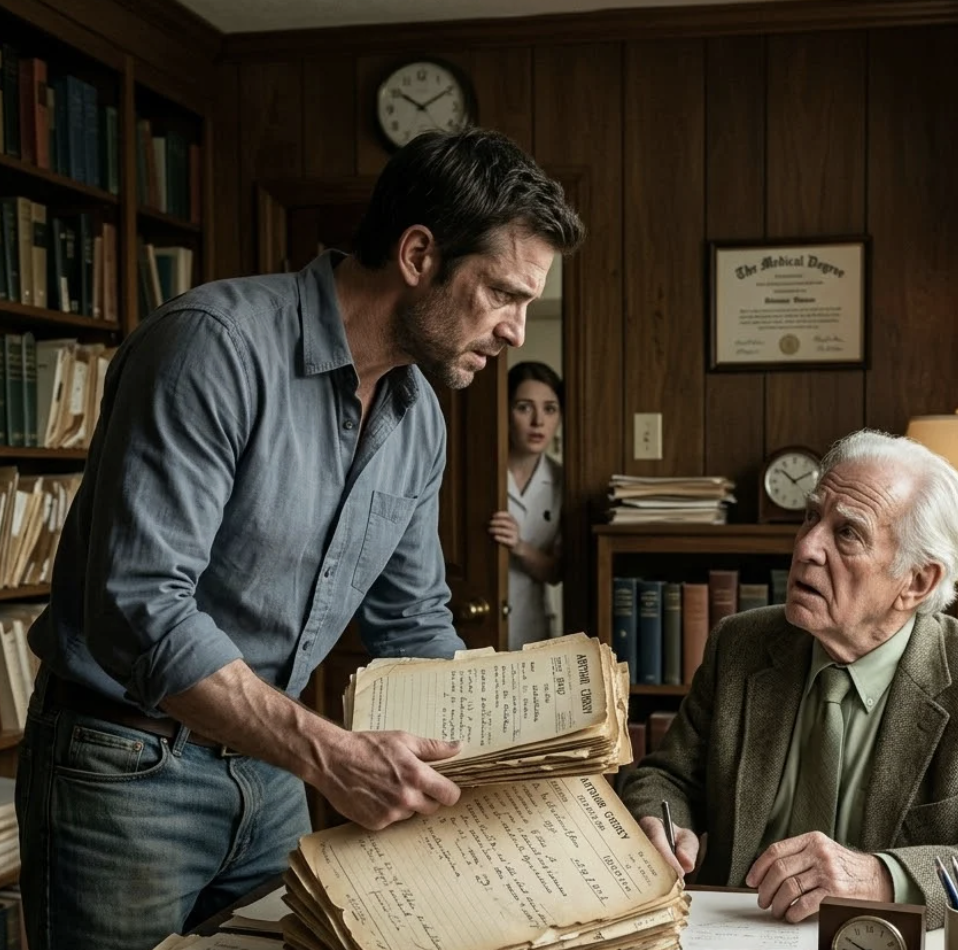
Then I met the doctor whose name appeared on my father’s medical records.
And he told me something that shattered my entire life.
“I’ve never treated anyone by that name.”
My father spent the last six months of his life locked inside a dark bedroom.
At least that’s how I remembered it.
The curtains were always closed.
The lights were always off.
The smell of medicine filled the hallway.
Whenever I asked to see him, my mother would stop me.
“Your father doesn’t want you to remember him this way.”
Sometimes I heard movement inside.
Sometimes I heard coughing.
Sometimes nothing at all.
The room became a forbidden place.
Then one morning, my mother sat me at the kitchen table.
Her eyes were red.
“Your father passed away during the night.”
The funeral happened three days later.
Closed casket.
Short service.
No viewing.
No questions.
And immediately afterward, we moved away.
At eight years old, I accepted everything.
Why wouldn’t I?
She was my mother.
For twenty years, the story never changed.
Dad died of cancer.
End of discussion.
Then, at twenty-eight, I began handling old insurance paperwork after my mother’s death.
Most of it was routine.
Until I found a folder labeled Medical Records – Thomas Carter.
My father.
Inside were hospital forms.
Treatment notes.
Prescriptions.
And the name of the oncologist who supposedly treated him.
Dr. Richard Lawson.
To my surprise, he was still alive.
Still practicing.
Something made me curious.
Maybe it was the missing paperwork.
Maybe it was the fact that many documents looked unusually clean for records that old.
Maybe it was instinct.
Whatever the reason, I made an appointment.
I expected a brief conversation.
Instead, I watched an elderly doctor stare at my father’s file in complete confusion.
Then he removed his glasses.
“I don’t understand.”
“What?” I asked.
He pointed at the signature.
“That’s not my signature.”
My stomach tightened.
“What do you mean?”
“I mean I never signed this.”
He flipped through several pages.
His expression darkened.
Then came the sentence that changed everything.
“I never treated your father.”
The room suddenly felt smaller.
“What?”
“There are no records of him in my system. None.”
He examined the documents again.
“The hospital numbers are incorrect.”
“The formatting is wrong.”
“The signatures are forged.”
I couldn’t speak.
For twenty years I had believed cancer killed my father.
Now the doctor himself was telling me the entire medical history was fake.
I left his office carrying more questions than answers.
Over the following weeks, I dug deeper.
Hospital archives showed no admission records.
No chemotherapy.
No scans.
No treatments.
Nothing.
Legally speaking, it was as if my father had never been a patient at all.
Then I found something even stranger.
The death certificate had been issued unusually fast.
The coroner’s report was missing.
And the funeral home had no surviving documentation regarding identification of the body.
Every trail led to another missing piece.
Another inconsistency.
Another lie.
Then I found an old neighbor.
A woman who had lived next door when I was a child.
At first she seemed reluctant to talk.
Then she asked a question.
“Did they ever tell you why your father kept screaming?”
My blood ran cold.
“Screaming?”
She nodded.
“For months before he died.”
She lowered her voice.
“We heard him at night.”
“I thought he was sick.”
Then she paused.
“Later I wasn’t so sure.”
The neighbor’s words haunted me.
Screaming.
Not coughing.
Not dying.
Screaming.
I returned to the old house.
The property had changed owners several times, but the current owner allowed me to look around.
The bedroom where my father supposedly spent his final months still existed.
Standing inside it felt surreal.
Then I noticed something hidden behind a replacement wall panel.
A small metal box.
Inside were receipts.
Prescription records.
And dozens of bottles.
Heavy sedatives.
Enough to keep someone unconscious for long periods.
The prescriptions weren’t written for my father.
They were written for my mother’s business partner.
A man named Victor Hale.
That name appeared repeatedly in financial documents from the same period.
As I investigated further, another secret emerged.
My mother had secretly sold a large portion of the family’s company.
The sale had generated millions.
But the signatures authorizing it were disputed.
According to archived correspondence, my father had threatened legal action shortly before his “illness” began.
Then everything suddenly made sense.
The fake cancer.
The closed room.
The isolation.
The rapid funeral.
Someone had needed my father removed.
But the truth became even stranger.
Months later, police reopened the case.
Financial records, witness statements, and newly discovered evidence painted a shocking picture.
My father had learned about the sale.
He confronted my mother.
Their relationship collapsed.
Soon afterward, he disappeared from public view.
According to investigators, he spent months confined inside the house under the influence of powerful sedatives.
Not because he was dying.
Because someone wanted him silent.
Then came the final revelation.
The body buried twenty years earlier wasn’t my father’s.
DNA testing confirmed it.
The man inside the grave was Victor Hale.
My mother’s lover.
The same man whose name appeared on the prescription bottles.
Authorities believe Victor accidentally consumed a lethal dose of medication originally intended to keep my father sedated.
Panic followed.
A dead lover.
A missing husband.
A collapsing scheme.
Faced with disaster, my mother made a decision that altered countless lives.
She placed Victor’s body inside the coffin.
Created the cancer story.
Forged the records.
And buried another man under my father’s name.
But the most disturbing mystery remained unsolved.
What happened to my father?
There was no body.
No death certificate.
No verified sighting.
No proof he ever died.
Only disappearance.
The official investigation eventually reached the same conclusion.
My father was likely alive when Victor was buried.
After that, nobody knew.
Maybe he escaped.
Maybe he ran.
Maybe someone helped him disappear.
Maybe he chose never to return.
Twenty years have passed since then.
I still don’t know where he is.
Sometimes I imagine he’s living under another name somewhere far away.
Sometimes I imagine he watches from a distance.
Sometimes I wonder if he’s been searching for me just as desperately as I’ve been searching for him.
What I do know is this:
The cancer was fake.
The medical records were fake.
The funeral was fake.
And the man buried as my father was someone else entirely.
Most people spend their lives visiting a parent’s grave.
I spent mine discovering it belonged to a stranger.
And somewhere out there, if fate has been kinder than truth usually is, my father may still be waiting to be found.
Leave a Reply