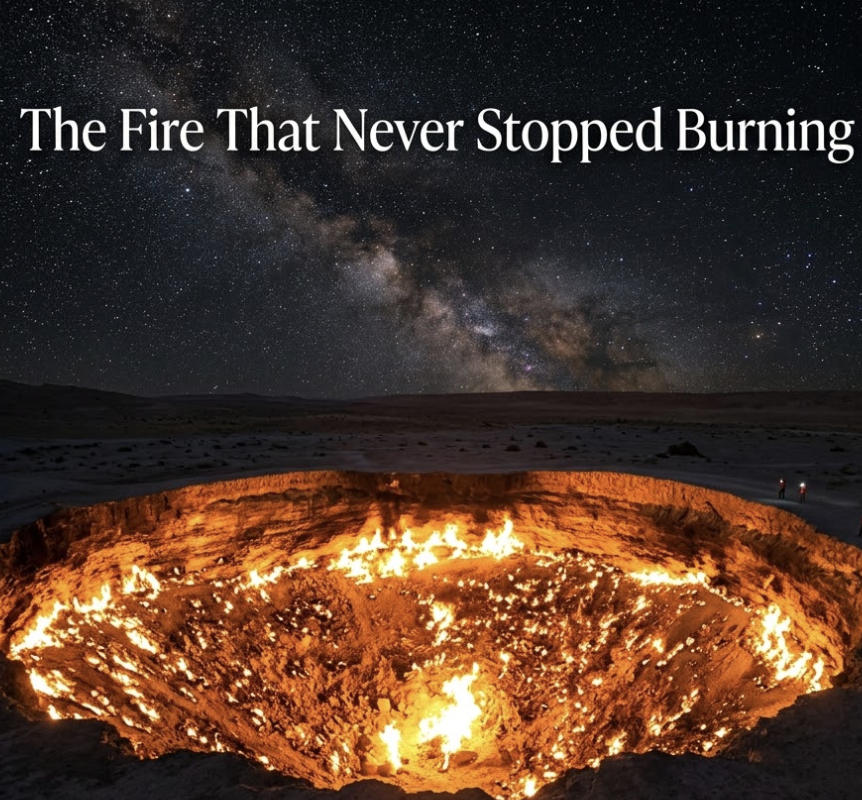
In the middle of a remote desert, a giant crater glows with fire day and night.
Its flames never seem to disappear.
They burn through scorching summers.
They burn through freezing winters.
They have burned for decades.
To travelers who see it for the first time, the sight feels almost unreal.
A massive pit filled with hundreds of flames stretches across the desert floor, lighting the darkness like a scene from another world.
Locals and visitors eventually gave it a dramatic name:
The Door to Hell.
Yet despite its frightening appearance, the story behind this famous crater is not rooted in myth or the supernatural.
It began with science, natural gas, and a mistake that no one expected would become one of the world’s strangest landmarks.
A Strange Sight in the Desert
The crater is located near the village of Darvaza in Turkmenistan, a country rich in natural gas reserves.
Today, it attracts travelers from around the world.
During daylight hours, it appears as a large sinkhole in the desert.
But after sunset, everything changes.
The pit glows orange.
Flames dance across the floor.
Heat rises into the night air.
From a distance, the crater looks like a giant wound in the Earth itself.
Many visitors describe the experience as both beautiful and unsettling.
Standing at the edge, they can hear the constant roar of burning gas and feel waves of heat rolling upward from below.
It is easy to understand why people began calling it the Door to Hell.
How the Crater Was Created
The story most commonly told about the crater begins in the early 1970s.
At the time, Soviet geologists were exploring the region in search of natural gas deposits.
The area sat above enormous underground reserves of methane.
During drilling operations, the ground beneath their equipment reportedly collapsed.
What had appeared to be solid earth suddenly gave way.
A massive crater opened in the desert.
The collapse revealed an underground pocket filled with natural gas.
Immediately, a new problem emerged.
Methane was escaping into the atmosphere.
The gas posed potential environmental and safety risks to nearby people and animals.
Engineers needed a solution.
The Decision That Changed Everything
Faced with a steady flow of methane, scientists made a decision that seemed perfectly reasonable at the time.
They would set the gas on fire.
The expectation was simple.
The methane would burn off within a short period.
Once the underground supply was exhausted, the flames would naturally die out.
The plan appeared straightforward.
No one imagined the fire would become famous.
No one imagined it would still be burning decades later.
Yet after the ignition, something unexpected happened.
The flames never disappeared.
The Fire Keeps Burning
Days passed.
Then weeks.
Then months.
The crater continued to burn.
Instead of running out of fuel, the underground gas reserves kept feeding the flames.
The fire became self-sustaining.
Year after year, methane continued rising through the earth and igniting at the surface.
What was intended as a temporary solution slowly transformed into a permanent spectacle.
As the decades passed, the crater became larger than life.
Travelers shared photographs.
Documentary filmmakers visited.
Scientists studied the site.
The Door to Hell evolved from an industrial accident into one of Central Asia’s most recognizable landmarks.
A Natural Wonder Born From Human Error
Part of the fascination surrounding the crater comes from the contrast between its appearance and its origin.
People often assume something so dramatic must have a mysterious explanation.
The reality is surprisingly ordinary.
There are no ancient legends behind the flames.
No hidden civilization.
No supernatural force.
Instead, the crater exists because natural gas became exposed and humans attempted to solve a problem using the knowledge available at the time.
Ironically, that solution created a much larger phenomenon than anyone expected.
The accident became more famous than the original drilling project itself.
Efforts to Extinguish the Fire
Over the years, government officials and scientists have periodically discussed ways to extinguish the flames.
Some argue that allowing valuable natural gas to burn indefinitely is wasteful.
Others point to environmental concerns associated with continuous methane emissions and combustion.
Several proposals have been considered.
Yet putting out the fire is easier said than done.
The underground gas system feeding the crater is complex.
Any attempt to extinguish it would require careful planning and significant resources.
As a result, the flames have continued burning while discussions about the crater’s future continue.
A Symbol of Curiosity
Today, the Door to Hell represents something larger than a geological curiosity.
It reflects humanity’s complicated relationship with nature.
People drill into the earth searching for resources.
They attempt to control natural forces.
Sometimes they succeed.
Sometimes unexpected consequences emerge.
The Darvaza crater serves as a reminder that even well-intentioned decisions can produce outcomes nobody predicts.
What began as a practical engineering solution eventually became one of the most unusual tourist attractions on Earth.
The Lasting Mystery
The most remarkable part of the story is not that the crater exists.
It is that it lasted so long.
The engineers who reportedly ignited the gas expected a temporary fire.
Instead, they created a landmark that survived for generations.
Children were born, grew up, and became grandparents while the flames continued to burn.
Entire governments changed.
Technology advanced.
The world transformed.
Yet the fire remained.
And perhaps that is why the Door to Hell continues to fascinate people around the globe.
Not because it is supernatural.
Not because it is mysterious.
But because it demonstrates how a single unexpected event can evolve into something far greater than anyone ever imagined.
A crater created by accident.
A fire meant to last days.
And a burning pit in the desert that became a legend.
Leave a Reply