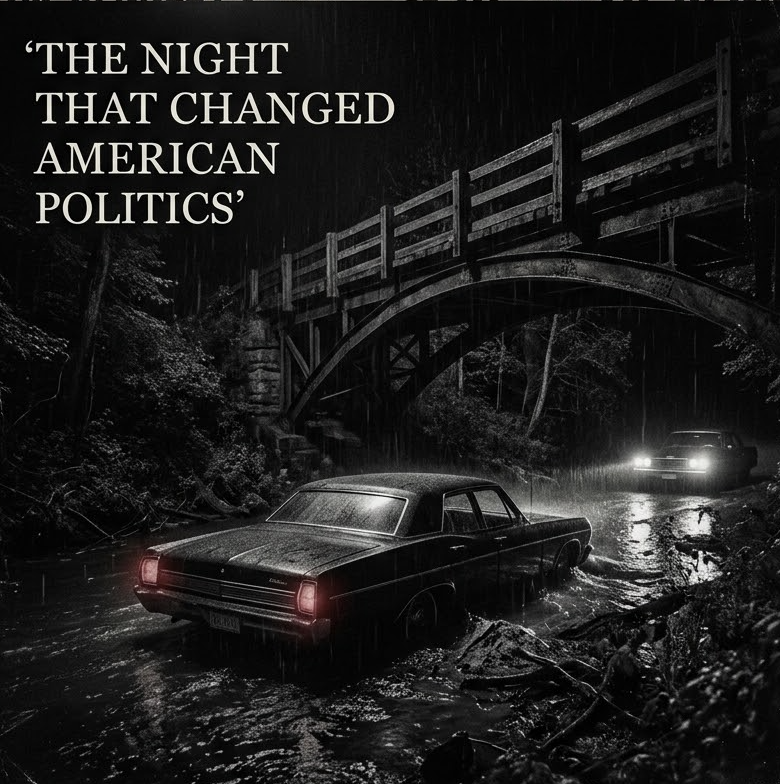
A car plunged off a narrow bridge into dark water.
A young woman lost her life.
And one of America’s most famous political figures became tied forever to a controversy that would follow him for the rest of his career.
More than half a century later, the events on Chappaquiddick Island remain one of the most debated episodes in American political history.
Not simply because of the accident itself.
But because of the questions that followed.
The Beginning
On the evening of July 18, 1969, Senator Ted Kennedy attended a gathering on Chappaquiddick Island, a small island near Martha’s Vineyard in Massachusetts.
The gathering brought together several women who had worked on the presidential campaign of Kennedy’s late brother, Robert F. Kennedy, who had been assassinated the previous year.
The atmosphere was informal.
Friends shared memories, conversations, and reflections on a difficult period in American history.
As the evening drew to a close, guests gradually began leaving.
At some point before midnight, Ted Kennedy departed with Mary Jo Kopechne, a 28-year-old campaign worker known for her intelligence and dedication.
Not long afterward, Kennedy’s car left Dike Bridge and plunged into the water below.
Kennedy escaped.
Mary Jo Kopechne did not.
What happened during the next several hours would become the focus of national attention and historical debate for decades to come.
The Accident
The crash itself was tragic.
But many observers believe it was the aftermath that transformed the event into a national controversy.
Questions began emerging almost immediately.
Why had the vehicle left the bridge?
What exactly happened in the moments before the crash?
Most importantly, why was the accident not reported to authorities immediately?
As details became public, journalists across the country began scrutinizing every aspect of the story.
Timelines were examined.
Statements were analyzed.
Witness accounts were compared.
Each new detail seemed to generate another question.
A Nation Watches
The accident occurred at a unique moment in American history.
Ted Kennedy was not merely a senator.
He was a member of the Kennedy family, perhaps the most famous political family in the country.
After the assassinations of President John F. Kennedy in 1963 and Senator Robert F. Kennedy in 1968, many Americans viewed Ted Kennedy as the remaining standard-bearer of the family’s political legacy.
Some believed he could one day become President of the United States.
Because of that possibility, the accident quickly became far more than a local news story.
The nation was not simply evaluating a traffic accident.
It was evaluating the character, judgment, and future of a man many saw as a potential president.
Public opinion became sharply divided.
Some people viewed the incident as a tragic accident compounded by poor decisions afterward.
Others believed important questions had never been fully answered.
The debate spread through newspapers, television broadcasts, political circles, and dinner-table conversations across the country.
The Long Shadow
Despite the controversy, Ted Kennedy continued his political career.
He remained in the United States Senate for nearly four more decades and became one of the most influential legislators of his generation.
His work shaped debates on healthcare, education, immigration, labor rights, and civil rights.
Yet no matter how many accomplishments followed, Chappaquiddick remained part of his public story.
Whenever discussions arose about presidential ambitions or the Kennedy legacy, the events of July 1969 resurfaced.
The accident became impossible to separate from his political identity.
For supporters, it represented a tragedy that should not define an entire lifetime of public service.
For critics, it remained evidence of questions that had never been fully resolved.
The Questions That Endured
Over the years, books, documentaries, journalists, and historians continued to revisit the case.
Many facts surrounding the accident became well known.
Yet debates persisted regarding the decisions made afterward.
The passage of time did little to diminish public fascination.
Part of the reason lies in the nature of the story itself.
The accident occurred on a small bridge in a remote location.
There were few witnesses.
Key moments unfolded away from public view.
As a result, the narrative was shaped not only by known facts but also by unanswered questions.
And unanswered questions often have a longer life than answers.
The Lasting Legacy
What makes Chappaquiddick such a significant historical event is not merely that a fatal accident occurred.
Tragic accidents happen every year.
What made this different was the collision between personal tragedy and national politics.
A single event on a quiet island became intertwined with the future of one of the most powerful political families in America.
For many historians, the greatest impact of Chappaquiddick was not confined to the night of the crash itself.
It was felt in the years that followed.
The accident became a permanent part of Ted Kennedy’s public image and a recurring obstacle whenever discussions turned to the presidency.
More than fifty years later, people continue to debate what happened, what should have happened, and how differently American political history might have unfolded if that night had never occurred.
In that sense, Chappaquiddick remains more than a tragedy.
It remains one of the most consequential “what if” moments in modern American politics.
Leave a Reply