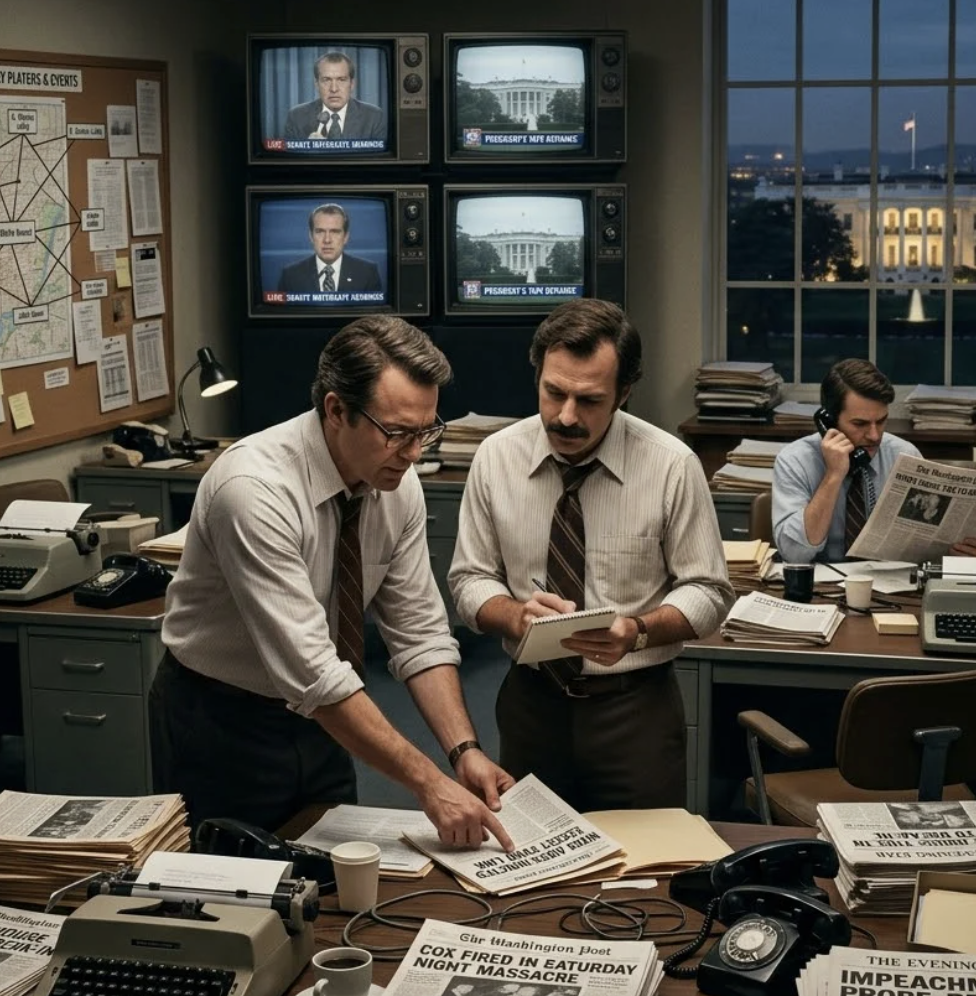
A late-night break-in.
A handful of men carrying surveillance equipment.
A political headquarters.
At first, it seemed like a strange but relatively minor crime.
Few people could have imagined that the incident would grow into one of the biggest political scandals in American history.
Or that a missing section of audio tape would become one of the most famous mysteries ever associated with the White House.
What began inside a building called Watergate eventually led to the resignation of a president and permanently changed how Americans viewed political power.
The Night of the Break-In
In the early morning hours of June 17, 1972, five men were arrested inside the headquarters of the Democratic National Committee at the Watergate complex in Washington, D.C.
The men were not ordinary burglars.
They carried cameras.
Electronic surveillance equipment.
Cash.
And tools that suggested they were conducting something far more sophisticated than a typical theft.
Initially, many people assumed it would be a short news story.
A political espionage attempt.
An embarrassing incident.
Nothing more.
But reporters soon noticed unusual connections between the suspects and individuals associated with President Richard Nixon’s reelection campaign.
Those connections raised difficult questions.
Who sent the burglars?
Why were they there?
And how far did the operation reach?
Following the Money
As investigators and journalists continued digging, the story grew larger.
Money linked to political organizations began appearing in unexpected places.
Witnesses changed statements.
Documents surfaced.
More names emerged.
The deeper investigators looked, the more complicated the scandal became.
Two young reporters from The Washington Post became particularly important in keeping public attention focused on the case.
Their reporting helped reveal that the break-in was not an isolated incident.
Instead, it appeared connected to a broader effort involving political intelligence gathering and attempts to obstruct investigations.
Over time, public concern grew.
The issue was no longer merely about a burglary.
It was becoming a question about honesty, accountability, and the abuse of political power.
The Secret Recording System
Then investigators discovered something extraordinary.
The White House contained a secret recording system.
Many conversations inside the Oval Office and other locations had been automatically recorded.
The system had originally been installed to preserve conversations and create an accurate historical record.
Instead, it became one of the most important pieces of evidence in American political history.
Suddenly, investigators knew that key discussions might exist on tape.
Not based on memory.
Not based on conflicting testimony.
Actual recordings.
The possibility changed everything.
If the tapes were released, they could confirm or contradict what officials had been saying for months.
The battle over those recordings quickly became the center of the entire scandal.
The Missing 18½ Minutes
Among all the recordings, one became especially famous.
A tape containing a conversation between President Nixon and his chief of staff, H.R. Haldeman, was found to contain an unexplained gap.
Approximately 18½ minutes of audio were missing.
The section had been erased.
The discovery shocked investigators.
Why was that portion gone?
Who erased it?
Was it accidental?
Intentional?
What had been discussed during those missing minutes?
The questions immediately became part of Watergate history.
Various explanations were offered over the years.
Some suggested human error.
Others believed the deletion was deliberate.
Despite extensive examination, no definitive answer ever fully resolved the mystery.
The missing audio remains one of the most discussed unanswered questions from the scandal.
Ironically, the gap itself became evidence of a larger problem.
People often assume destroyed evidence makes a story disappear.
In this case, the missing section made the controversy even bigger.
The Tapes That Remained
Although one section was missing, many other recordings survived.
And what remained on those tapes proved devastating.
Investigators, prosecutors, Congress, journalists, and the public gained access to conversations that painted a troubling picture.
The recordings suggested that senior officials had participated in efforts to manage, limit, and obstruct investigations.
The issue was no longer simply the original break-in.
The growing concern became the response afterward.
Again and again, investigators found that attempts to conceal information often caused more damage than the original misconduct itself.
The surviving tapes became powerful evidence because they captured conversations in real time.
Unlike testimony given months later, the recordings preserved events as they happened.
That made them extraordinarily difficult to dismiss.
The Collapse of a Presidency
As public pressure intensified, political support for Nixon began to weaken.
Members of Congress from both parties grew increasingly concerned.
Impeachment proceedings moved closer.
Court decisions required additional evidence to be released.
Each new development increased the pressure.
Eventually, the situation reached a breaking point.
On August 8, 1974, President Richard Nixon announced his resignation.
The following day, he left office.
He became the first U.S. president in history to resign.
The Watergate scandal permanently changed American politics.
It strengthened expectations for transparency.
Expanded investigative journalism’s influence.
And reminded future administrations that even the highest offices could face scrutiny.
The Twist That Made Watergate Unforgettable
Many people remember Watergate as a burglary.
But history remembers it as something much larger.
The break-in itself was serious.
Yet it was not the event that ultimately brought down a presidency.
What transformed Watergate into a historic scandal was the effort to hide what had happened.
The most remarkable irony is that some of the strongest evidence did not come from political opponents, investigators, or journalists.
It came from recordings created inside the White House itself.
The very system intended to preserve history became the mechanism that exposed it.
And that is what makes Watergate such a powerful lesson.
The scandal was not simply about a door opened during a break-in.
It was about the belief that power could control the truth.
In the end, the evidence that caused the greatest damage was evidence that had been recorded by the system trying to document events in the first place.
Almost as if the truth had quietly preserved its own witness long before anyone realized it would be needed.
Leave a Reply